
Key Takeaways
- Six deliverables make a machine: structure, game logic, payment peripherals, harness and power, assembly with burn-in, and conformity testing. They rarely come from one party.
- Pick the supplier type by what you already own - a board and a brand, a design only, or nothing but a market - not by who quotes lowest.
- Every deliverable needs a named acceptance document. A scope that names parties but not documents is not a scope.
- Configuration freeze is the hinge: after prototype sign-off, any change should carry a revision number, a cost line and a re-test decision.
- Certification is a project, not a product attribute. The certificate belongs to a configuration, not to a factory.
- A supplier that cannot tell you which parts are made in-house, sourced, or partner-built is telling you something.
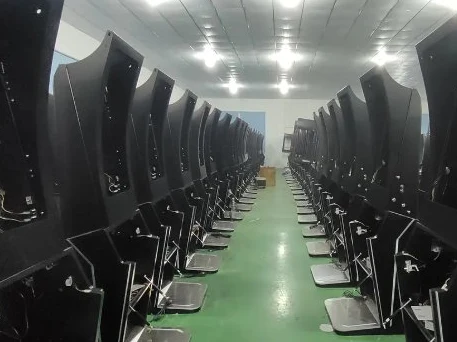
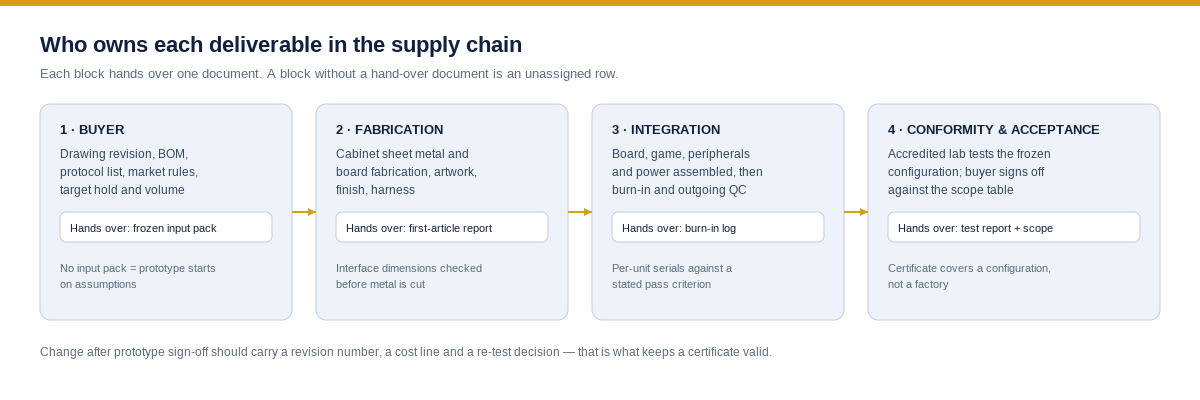
Most sourcing mistakes in this category are scope mistakes made before the first quote. A buyer assumes the machine supplier builds the cabinet; the supplier assumes the buyer supplies the board; the lab assumes the configurations are identical. The build then stalls at the point where nobody owns the interface. The fix is mechanical: write the six deliverables down, name one owner for each, and demand one acceptance document per deliverable. The three buyer questions that follow from this - who assembles, who tests, who signs - are covered in the value chain breakdown, while the physical build sequence is on the manufacturing process page.
Who Builds Each Part of a Slot Machine?
Split the machine into six deliverables. Each one has a typical owner, an input the buyer must supply, and a document that proves the work happened. Where a supplier cannot name the owner of one row, that row is unassigned and will surface later as a schedule slip or a rework charge.
| Deliverable | Typical owner | Input you must supply | Acceptance document |
|---|---|---|---|
| Cabinet structure and sheet metal | Cabinet OEM - for our builds, the group's Foshan plant | General-arrangement drawing with tolerances, finish spec, print-ready artwork, service access requirements | First-article inspection report plus dimensional report against the drawing revision |
| Game logic, math and RNG | In-house software team, or a licensed third-party studio | Target market rules, target hold and volatility, paytable intent, jurisdiction test requirements | Firmware version log and the math or RNG certificate scope for the tested build |
| Payment peripherals | Peripheral vendors, integrated by the assembler | Protocol (MDB, SAS or proprietary), currency and denomination set, bezel aperture, ticket or hopper decision | Interface test record showing accept, reject and payout cycles on the actual board |
| Harness and power distribution | Assembler | Board pinout, full peripheral list, load table, target supply voltage and frequency for the destination | Continuity and load test sheet, plus as-built wiring diagram |
| Assembly, burn-in and QC | Assembler - our Panyu base for integrated builds | Build documentation, agreed burn-in duration, pass and fail criteria, packing spec | Burn-in log with per-unit serials and an outgoing QC report |
| Conformity testing and certification | An accredited lab, engaged per destination market | Configuration freeze, full BOM, sample units from the production build | Test report plus the certificate scope, which names standards and configuration, not the factory |
The board itself is worth separating from the game logic, because they are bought differently. A board is a piece of hardware with a fabricator and a revision; the game is software with a version and a math model. For our own builds the PCB design and firmware are ours, fabrication and SMT run through a qualified Shenzhen fabricator against our files, and assembly with burn-in sits in Panyu. That split is written into the SOW rather than summarised as one factory claim, because each leg has a different failure mode and a different fix.
The practical consequence: when a buyer asks "do you make the whole machine", the useful answer is a list, not a yes. A supplier who answers with a list has a scope document behind the answer.
Cabinet OEM vs Complete-Machine Supplier vs System Integrator
Three supplier types cover most builds, and the choice is set by what you already own rather than by price. A brand owner with a finished game should not buy a complete machine; a route operator entering a new market should not buy an empty shell.
| Cabinet OEM | Complete-machine supplier | System integrator | |
|---|---|---|---|
| What you buy | Structure, sheet metal, finish, harness, sometimes power and display mounting | A working machine: cabinet, board, game, peripherals, tested as one unit | A venue or floor system: machines plus the management, accounting and ticketing layer |
| What you keep | Game, board, firmware, certification strategy, brand | Brand, market access, commercial terms, sometimes the game IP | Site, licence, operations, staffing |
| Typical failure | Cabinet arrives, board does not fit the aperture or the harness does not reach | Game performs differently from the reference machine you approved | Machines run, but the reporting layer does not match the operator's accounting |
| Best fit | You have a certified board and a design, and need volume | You have a market and a brand, and need a product | You are equipping a floor and want one throat to choke |
| First question to ask | Which interface dimensions do you hold to, and against whose drawing? | Whose board, whose math, and what is the tested configuration? | Which management system, and who owns the integration test? |
The integrator role is the one most often misread. It is not a bigger version of a machine supplier: the deliverable is a working floor with accounting that reconciles, and the risk sits in the interface between machines and back office. If the management system is chosen after the machines, that interface becomes the buyer's problem.
Mixed models are normal and legitimate. A build can take a cabinet from one party, a board from a second and assembly from a third. What is not legitimate is leaving the interfaces unassigned and calling the result a turnkey project.
Producers, Manufacturers and Suppliers Are Not the Same Party
The three words are used interchangeably in search results and mean different things in a scope document. A producer is whoever originates the game - a studio, an in-house team or a licensee. A manufacturer is whoever builds hardware, which may be a cabinet shop, an assembler or both. A supplier is whoever sells to you, and may build nothing at all.
This matters when you compare quotations. Two quotes for the same machine can both carry the word manufacturer while one includes game origination and the other assumes you bring it. Ask which of the three roles the company actually holds, and for which of the six deliverables. A trading company that answers supplier only is not a worse answer - it is a clearer one, because it tells you where the engineering responsibility sits.
For buyers starting from the question of who makes slot machines at scale, the useful next step is not a ranking but a scope table: name the candidates, then ask each one to fill in the same six rows. The manufacturer capability page shows how ours is filled in.
What to Verify at Prototype, Pilot and Production
The same questions get different answers at three stages, and buyers who ask the production-stage questions at prototype stage get optimistic answers. Stage the evidence instead.
Prototype: freeze the configuration
At prototype the deliverable is a frozen configuration, not a pretty machine. Freeze means: a drawing revision, a BOM revision, a firmware version and a peripheral list that all reference each other. Ask for the interface drawing set that shows board mounting holes, display aperture, harness routing and service clearance. Then make the supplier restate, in writing, which of the six deliverables sit inside their scope and which sit outside.
A one-line confirmation of "configuration frozen as of revision X" is worth more than a photo of a working unit, because the photo cannot be re-tested.
Pilot: prove the process, not the unit
A pilot batch answers a different question: can the line repeat the prototype. Ask for the burn-in log with per-unit serials and the incoming inspection record for the batch's components. Where the destination market needs conformity testing, the pilot units are the ones that should go to the lab, because a certificate issued on hand-built samples does not cover a production build.
Production: control the change
Production risk is change. Ask what happens when a component goes end-of-life, and who decides. A workable answer names a change-control route: the supplier proposes, the buyer approves, the revision number moves, and a re-test decision is recorded. A supplier who says component substitution is handled internally has just described an uncontrolled configuration, which is the fastest way to invalidate a certificate.
Supplier Evaluation Checklist
Send this as a document, not as interview questions. Written answers are comparable; spoken answers are not. Twelve items, four groups.
Scope and responsibility
- Which of the six deliverables are in your scope? A qualified answer lists them and names the parties for the rest. A vague answer is "we do everything".
- Which parts are made in-house, which are sourced, and which are partner-built? The answer should be a table, not a sentence.
- Who signs final acceptance, and against which document? If the answer is the salesperson, keep asking.
Engineering control
- Which drawing revision will you build to, and how do you record changes? Look for a revision table with dates and approvers.
- How do you confirm a board fits before cutting metal? The credible answer involves a mounting and aperture check against the board's own drawing, not a sample photo.
- What is your burn-in duration, and what counts as a fail? A duration without criteria is a delay, not a test.
Quality evidence
- Can you show one first-article report and one outgoing QC record? Redacted customer names are fine; the document format is the point.
- What are your documented quality processes, and who audits them? Describe the process you can evidence, and do not turn a management-system claim into a certificate.
- What happens to a unit that fails outgoing QC? The answer reveals whether rework is tracked or invisible.
Commercial and conformity
- Is certification in your scope or mine? Certification is a project against a configuration and a market; it is never a free attribute.
- What is your lead-time trigger? Artwork approval, drawing sign-off and deposit release start different clocks. Name the trigger or the lead time means nothing.
- Which terms are negotiable and which are fixed by the build? Good suppliers separate the two; weak ones negotiate everything and deliver nothing on time.
Score each answer as documented, asserted, or absent. Two absences in scope and one in engineering control is enough reason to keep looking.
FAQ
Does one factory build the whole slot machine?
Usually not. Cabinet sheet metal, board fabrication, peripheral supply, assembly and conformity testing are commonly separate operations even when one supplier sells the finished machine. The useful question is not whether one factory builds it, but which party owns each deliverable and which document proves it.
What is the difference between a cabinet OEM and a complete-machine supplier?
A cabinet OEM supplies structure, sheet metal, finish and often harness, and leaves the game, board and certification to you. A complete-machine supplier delivers a tested unit including board, game and peripherals. The first suits buyers who already own a certified board; the second suits buyers who own a market and a brand.
Who is responsible for certification in an OEM project?
It is assigned, not assumed. Testing runs through an accredited lab and applies to a configuration for a market, so the buyer usually holds the certificate while the supplier supplies the frozen configuration, BOM and sample units. Write the split into the SOW, because a certificate issued for a different configuration does not transfer.
How do I check that a supplier actually controls its configuration?
Ask for a revision table on one drawing and one BOM, with dates and approvers, and ask what happens when a component goes end-of-life. A controlled process produces a small set of documents and a named decision route. An uncontrolled one produces reassurance instead.
What should a first OEM order include before assembly starts?
Four things: an approved general-arrangement drawing with a revision number, a frozen BOM, a peripheral list with protocols, and a written scope table naming the owner of each of the six deliverables. Without these, assembly starts on assumptions and the rework lands on whoever has the least leverage.