
Key Takeaways
- The skill game board is where your compliance story physically lives: secure boot, signed firmware and a revision record a lab can trace.
- A bought-in board makes your certification somebody else's paperwork. An in-house PCB keeps the whole chain with one engineering team.
- Certifications (GLI / BMM / CE) are scoped per market and per order — never implied as blanket approval.
The skill game board is the least photographed, most audited part of the machine. Players never see it. Regulators, testing labs and compliance counsel see nothing else. When a state asks what your machine actually is — gaming device, amusement device, something in between — the answer is read off this PCB: its firmware, its security architecture, its revision record.
Answer up front: buy the board from the team that designs it, manufactures it and signs the documentation. GOLDPRIME GAME builds the skill game PCB in-house — schematic, layout, SMT, firmware, test — as part of the same program that builds your skill game machines. One engineering team owns the whole chain, which means one engineering team answers the phone. We supply the hardware, the software and the documentation; operating licenses and local compliance sit with the buyer.
This page covers the board itself: architecture, security, per-market game logic, the kit option for your own cabinets, and the testing chain. If you are sourcing the RNG-driven equivalent for casino-style product, that is our slot machine board page — different math, shared security DNA.
What a Skill Game Board Actually Is
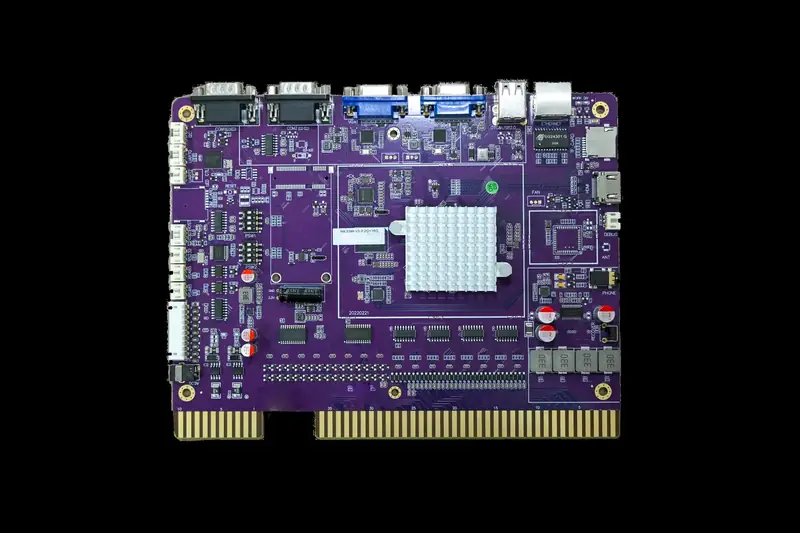
A skill game board is the control electronics of a skill game machine: the processor, memory, power regulation, input/output lines for buttons and touch, the display interface, the payout-device interface, and the firmware that ties them together. On top of the hardware sits the game logic — the code that decides how a nudge window opens, how a skill-stop resolves, what gets logged.
Three properties separate a gaming-grade board from an industrial PC in a box. Determinism — the same inputs produce the same documented behavior, every boot, for years. Auditability — every event a regulator cares about is logged in a tamper-evident form. Traceability — the shipped unit maps to a revision record, a bill of materials and a firmware image, so "what is inside this machine" is a lookup, not a teardown.
That third property is where integrator-sourced machines quietly die. A board bought from a catalog has someone else's revision policy and someone else's end-of-life calendar. When the catalog changes, your certification file starts lying.
Architecture & Key Features
The board is engineered as a gaming control system, not adapted from a kiosk platform.
Processing and memory. Industrial-grade SoC with wide-temperature rating, soldered storage for the firmware image and game assets, and enough headroom that a per-market software load never runs at the edge of capacity. Sustained performance matters more than benchmark numbers: a board that throttles in a warm back-bar develops "random" faults that are not random at all. Storage is partitioned so the game assets can update without touching the signed boot chain.
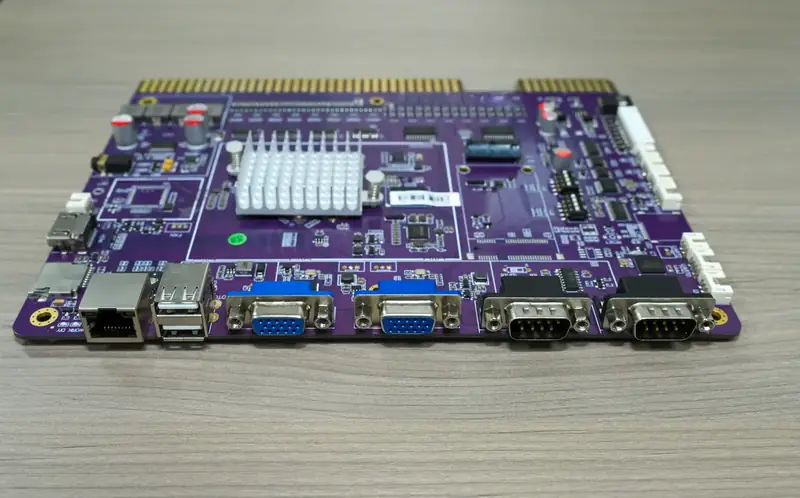
I/O engineered for the cabinet. Button-matrix inputs with debounce in hardware, touch controller interface, dual-display support, ticket printer and note-acceptor ports, door and security switches, and a network interface for markets that require or permit reporting. The I/O map is configured per project — your cabinet, your peripherals, your connector positions. Debounce belongs in hardware because a nudge judged by a bouncing contact is a dispute with a player waiting to happen.
Power and protection. Venue electricity is dirty. The board carries surge protection, brown-out handling and a clean shutdown path so a power flicker is a log entry instead of a corrupted image. Route technicians see the difference in the first storm season: boards with real power design come back for cleaning, not for replacement.
Security: Secure Boot, Signing, Tamper Evidence
Security on a skill game PCB is not a feature list; it is the chain of custody for your license.
Secure boot means the board verifies every stage of its startup against a cryptographic root. An unsigned or altered image simply does not run. Firmware signing ties each software load — including the per-market game logic — to a documented revision, so the file on the machine matches the file in your compliance paperwork. Tamper-evident logging records door opens, image changes, configuration writes and payout events in a form designed to survive scrutiny.
The measure set is not one-size-fits-all, because the technical standards are not one-size-fits-all. A state that regulates skill games as gaming machines will ask for more than a state that treats them as amusement. We scope the security configuration per market and per order, and we document what was implemented — certifications (GLI / BMM / CE) are scoped per market and per order, never implied as blanket approval.
Per-Market Game Logic
This is where a skill game board earns its name. The board does not ship with one global game; it ships with a signed software load compiled for your jurisdiction.
Nudge window width, skill-stop resolution, pattern difficulty, recall timing, maximum session behavior, reporting fields — each parameter is set against the target market's rules and frozen into the load. Change markets, and the load changes with documentation to match. The skill game software page covers the engine and math side; the board's job is to run that load deterministically and prove that it did.
Our RNG engineering team handles the chance elements inside hybrid titles, and our PCB design team owns the hardware those loads run on — same building, same revision system. When a state tightens a definition, the response is a new signed load and a documented parameter change, not a hardware recall.
Fleet operators should plan for load management from day one. Different states mean different signed loads across the same hardware revision, and the machine's own records must show which load it runs. Our boards report the load identity in the standard log stream, so a fleet audit is a report query, not a truck roll. When Pennsylvania-style regulation reaches your state — and the Pennsylvania skill games page tracks how fast that wave is moving — the operators with load discipline adapt in weeks. The ones without it start over.
Skill Game Board vs. Slot Machine Board
Buyers who run both product families ask whether one board can cover both. The honest answer: the hardware can be shared, the paperwork cannot.
A slot machine board and a skill game board share the security architecture — secure boot, signed images, tamper-evident logging, revision control. If you walk our SMT line, the two look like siblings. The difference sits in the game logic and the certification story. Slot firmware resolves every outcome on a certified RNG and documents that RNG for the lab. Skill firmware documents the player-input mechanics — the nudge window, the stop resolution, the recall task — and how those mechanics interact with any chance elements in the title.
The practical consequence for procurement: do not let a vendor sell you a slot board "with a skill mode." Regulators read the firmware, not the brochure, and a slot math model wearing a skill costume is exactly the artifact that turns a licensing review into an enforcement file. Order the board whose documented logic matches your licensed category. We build both, we document both, and we will tell you which one your market requires — that scoping is part of the quote, not an upsell.
OEM/ODM Custom Board Programs
When the standard I/O map does not fit, the board adapts — that is the point of owning the design. Through our OEM/ODM services, custom scope covers connector positions, peripheral sets, form-factor constraints, security measure sets and the firmware build itself.
Typical custom triggers: a legacy cabinet with fixed mounting holes; a proprietary button deck a distributor wants to keep; a market requiring a reporting interface the standard map does not carry; a white-label program where the boot chain must show the operator's brand from the first pixel. Each is normal engineering work when the schematic lives in-house, and each is a month of vendor negotiation when it does not.
Custom programs follow the same discipline as standard ones: a configuration document you sign, engineering samples, a pilot run, then volume on a frozen revision. Exclusivity is available per program — your I/O map and your firmware loads are yours, and they do not appear in another customer's machine.
Compliance & Documentation
Every board ships with a file, and the file is the product as much as the FR-4.
The documentation set covers the board revision record, the bill of materials, the test records by serial number, the signed software load manifest and the security implementation notes. For markets moving through lab review, our GLI certification capability prepares the submission side: the same documents, formatted for the certifier, with engineering available when the lab has questions. For U.S. state work, the U.S. skill-game solution page explains how builds are scoped jurisdiction by jurisdiction.
Two commitments stay fixed across every program. We are an equipment and software supplier — machines, boards and code — with licensing and compliance in your market sitting with you. And certifications (GLI / BMM / CE) are scoped per market and per order — never implied as blanket approval. A board vendor who promises "certified everywhere" is telling you the certification will be your problem, not theirs.
The Skill Game Kit Option
Not every buyer needs our sheet metal. Distributors with their own cabinet line, and operators refreshing existing enclosures, order the skill game kit: control board, software load, harness map, mounting specification and integration documentation.
Kit programs run like this. You send the cabinet constraints — internal dimensions, peripheral list, power budget, connector preferences. We configure the I/O map and firmware to match, ship engineering samples, and iterate until the integration is clean. Pilot run follows, then volume on the same revision. The kit is also how a fleet transitions: an older enclosure with documented structure gets a new compliant board and a new software load, and the asset lives a second life.
Illustrative example, not a specific client. A distributor held 400 older cabinets whose original board supplier had exited the market. Replacing the enclosures would have cost more than the routes earned in a year. A kit program re-mapped the I/O to the existing harness, put a current skill game board and a state-scoped software load inside each cabinet, and returned the fleet to documented operation. The cabinets kept their serial history; the electronics finally had a paper trail.
The cabinet side of that equation — if you decide the enclosure should be ours after all — is on the skill game cabinet page.
Manufacturing & Test Chain
Boards are built on our own SMT lines and tested as gaming products, not consumer electronics.
- AOI after SMT — every solder joint inspected before the board moves.
- In-circuit test — nets, values and orientation verified electrically.
- Functional test — each board boots on a fixture that simulates the cabinet: buttons, touch, display, printer, door switches.
- Burn-in — sustained load at elevated temperature to force infant-mortality failures out before shipping, not after installation.
- Per-unit verification — firmware version, boot signature and I/O response recorded against the serial number.
The output of that chain is a board with a file: revision, BOM, test record, software load. That file is what your lab submission and your license application are built from.
Board, Cabinet, Software: Buy the Stack or Buy the Layer
The board is one layer of three. Some buyers need only the layer — the kit route above. Most need the stack: board, cabinet and software engineered as one product, which is the skill game machines pillar. Either route is a normal program for us; what we do not do is sell undocumented boards into unlicensed operation.
Send your jurisdiction, cabinet plan and target volume. We come back in about 72 hours with a scoped board or kit configuration — I/O map, security measure set, software load and certification pathway, priced from a single engineering sample upward. Request a quote or contact the team to open the scoping call. The board is where your compliance file starts; start it with the team that built it.
Frequently Asked Questions
What is a skill game board?
A skill game board is the control PCB inside a skill game machine: processor, memory, I/O, power regulation, security hardware and the firmware that runs the game logic. It is the layer a testing lab audits and the layer a regulator asks about first when a machine's classification is questioned.
How is a skill game board different from a slot machine board?
Both are gaming control PCBs with secure boot and signed firmware. The difference is the game logic: a skill game board runs mechanics with a genuine player-input element — nudge windows, skill-stop resolution, recall tasks — while a slot machine board resolves outcomes on a certified RNG alone. The security architecture is shared; the math is not.
Do you sell skill game kits for our own cabinets?
Yes. A skill game kit pairs the control board with a software load, wiring harness map and integration documentation for your enclosure. Kits are scoped per project: send the cabinet constraints and peripheral list, and we configure the I/O map and firmware image to match before anything ships.
What security features does the board have?
Secure boot that refuses unsigned images, firmware signing tied to a documented revision, tamper-evident event logging and sealed-enclosure support. The exact measure set follows the target market's technical standard, which is why we scope it per order rather than shipping one global configuration.
Can the game logic be configured per state or market?
Yes, and this is the normal case. Nudge windows, skill-stop resolution, difficulty and reporting fields are compiled per market into a signed software load. The load manifest goes into your compliance file so the machine a regulator inspects matches the document you filed.
What testing happens before a skill game PCB ships?
Boards pass automated optical inspection after SMT, in-circuit test, functional test on a fixture that simulates the cabinet's peripherals, and a burn-in cycle under sustained load. Firmware version, boot signature and I/O response are verified per unit, not sampled per batch, and the results record against the serial number.
What is the MOQ for custom skill game boards?
From a single prototype. Board programs normally start with engineering samples for cabinet integration, then a pilot run, then volume. Lead time runs 12–42 working days depending on customization, and a scoped quote comes back in about 72 hours.
Who owns the board design — you or us?
Standard programs: we retain the design and you get revision-controlled supply with long-term availability commitments. OEM/ODM programs can assign custom I/O maps and firmware builds to your exclusive use under contract. Either way, the revision record and certification chain stay documented, auditable and tied to your orders.
Will the same board still be available in three years?
Yes — revision control and component lifecycle management are part of the product. When a component goes end-of-life, we re-spin the board and document the new revision so spares ordered years later still boot in cabinets built on day one. That continuity is what a bought-in board cannot promise.