
Key Takeaways
- A slot machine PCB is the electronics layer: stackup, MCU, I/O and power. The game content that runs on top of it is a separate purchase.
- An in-house slot RNG module is what makes a certification chain auditable. A bought-in board makes it somebody else's paperwork.
- Revision control on the board is why a spare ordered in year three still boots in a cabinet built in year one.
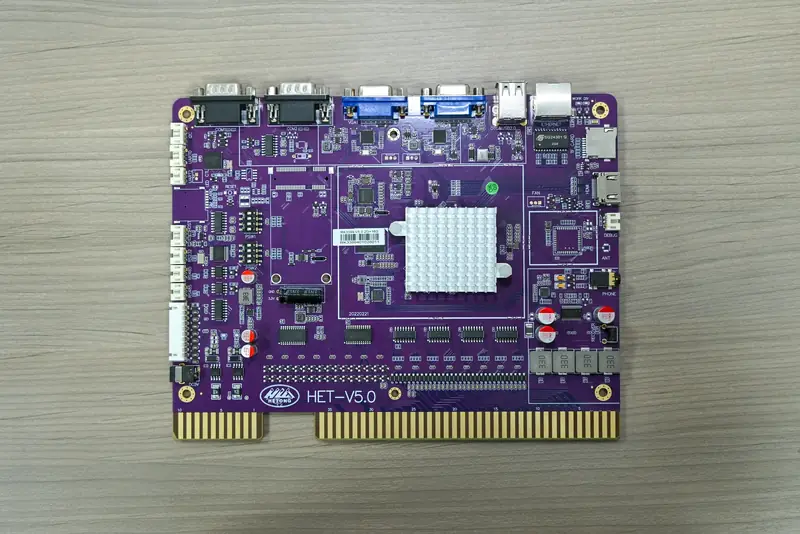
The slot machine PCB is the part of a cabinet that nobody photographs and everybody depends on. It carries the processor, the memory, the RNG module, the input and output lines, the power regulation and the network interface. When a floor develops intermittent faults that nobody can reproduce, this board is usually where the answer lives.
At GOLDPRIME GAME the slot machine manufacturer is also the board designer. Our PCB design and RNG engineering teams own the schematic, the layout, the firmware and the RNG module. This page is the engineering view. If you are sourcing complete game content rather than electronics, you want our slot game software instead.
What Is a Slot Machine PCB?
A slot machine PCB is the printed circuit board that runs a gaming cabinet's electronics: processor, memory, RNG module, I/O lines, power regulation and network interfaces. It is the hardware layer. The titles, artwork and paytables that run on top of it are a separate product with a separate specification.
That distinction is not pedantry. It decides which quote you should be reading.
Slot Machine PCB vs Slot Game Board — Which Do You Need?
Two different products, two different buyers, and a vocabulary that does nobody any favours.
| Slot machine PCB (this page) | Slot game board | |
|---|---|---|
| What it is | The electronics: stackup, MCU, RNG module, I/O, power | The content: titles, art, math, paytables, rules |
| Who buys it | Engineering and manufacturing teams | Operators and distributors |
| The question you are asking | Will this board run reliably in my cabinet for five years? | Will these games earn on my floor? |
| What you specify | Layer count, interfaces, connectors, firmware, RNG scope | Title count, themes, hold and RTP, format |
| Certification angle | RNG entropy, tamper evidence, build record | Math model approval, content provenance |
The electronic board is one component of a complete board solution. If you are buying whole cabinets or refreshing a floor's content, start at slot game software and come back here when the engineering questions surface. Most programmes eventually need both, specified together.
Board Specification Summary
The engineering scope in one table. Each line is expanded in the sections below.
| Item | Typical configuration |
|---|---|
| Board stack | Mainboard · RNG module · I/O board · link board · power distribution |
| PCB material | FR-4, moving to high-Tg laminate where thermal load justifies it |
| Layer count | Typically four to six layers with dedicated ground and power planes |
| RNG | In-house slot RNG module: hardware entropy source, conditioning, continuous health tests |
| Interfaces | Serial and USB peripheral buses, bill validator, thermal printer, hopper, card reader, button deck, display and touch controller, network |
| Firmware | Signed images burned to a named revision, recorded on the build record |
| Production test | SMT → AOI → in-circuit test → functional test on cabinet fixture → burn-in |
| Compliance | Tamper-evident chain of trust; GLI, BMM and CE pathways scoped per market |
Board Stackup and Materials
Gaming mainboards run hot, run continuously, and sit inside cabinets with imperfect airflow. That drives the material choice.
We build on FR-4, moving to high-Tg laminate where the thermal load justifies it. Layer counts are typically four to six, with dedicated ground and power planes rather than shared pours. The reason is boring and important: a board that saves two layers saves a small amount per unit and costs a great deal in intermittent faults that surface eighteen months later, in someone else's venue, at midnight.
Copper weight, trace geometry and impedance control are specified against the actual harness lengths in the cabinet, not against a generic reference design. Because we build the cabinet too, those lengths are known numbers rather than assumptions.
The Gaming Mainboard: Processing, Memory and Interfaces
A modern gaming mainboard is a small industrial computer with an unusually demanding I/O list.
- Processing and memory sized for the graphics load of the target cabinet, with headroom for content that has not been written yet
- Peripheral interfaces for bill validator, thermal printer, hopper, card reader and button deck, using standard serial and USB protocols
- Display output matched to panel resolution, orientation and the touch controller, which is where bought-in displays commonly cause silent failures
- Network for link jackpots, CMS reporting and player tracking
- Power distribution with regulation and protection sized for peripheral inrush, not just steady-state draw
Interface choices are where retrofit compatibility is won or lost. Send us your existing harness and connector block and we will tell you what adapts cleanly and what does not.
In-House Slot RNG Module
The slot RNG module is the component that makes everything else auditable.
Random number generation in a certified machine is not a software function calling a system clock. It is a hardware entropy source, a conditioning stage that removes bias, continuous health tests that detect drift or stuck output, and a mapping layer that turns conditioned entropy into game outcomes. Each of those four stages is something a certification lab will look at directly.
Designing the module ourselves means we can answer questions about all four. A manufacturer who buys the board in can only forward your question to a supplier who has no contractual relationship with you and no obligation to answer quickly. We have watched that conversation delay a market entry by a full quarter.
Certification pathways for GLI, BMM and CE are supported per market and per order. Scope follows your jurisdiction, and it is set out in our certification capability.
Firmware, Rule Burn-In and Revision Control
Firmware is written, signed and burned to a named revision. That revision goes on the build record alongside the board.
Signed images refuse to boot if they have been altered, which matters less as a theft deterrent than as a guarantee that the machine on your floor is running the code that passed certification. A field technician cannot accidentally flash a machine back to an unapproved build.
Revision control is also the unglamorous reason spare parts work. A board ordered in year three still boots in a cabinet built in year one, because the revision is a record rather than a memory.
From Prototype to Volume
Prototype boards are hand-assembled and bench-tested before any tooling is committed. Volume production runs through SMT with automated optical inspection, in-circuit test, then functional test on a fixture that simulates the cabinet's peripherals rather than checking continuity and calling it done.
RNG output is statistically sampled during functional test. Designing a sound entropy source and never measuring the shipped units is a common gap, and it is the kind of gap that surfaces during an audit rather than during production.
Boards then run a burn-in cycle, because the failures worth catching are the ones that appear in the first hours of operation.
Tamper Evidence and the Compliance Chain
Regulated markets care less about how clever the board is than about whether the shipped board is provably the tested board.
That chain is built from sealed enclosures with break-on-open indicators, logged access events, signed firmware, and a build record naming the board revision, the firmware revision and the RNG module version. Specific requirements vary widely by jurisdiction and are scoped per market.
Because the PCB design, the RNG and the cabinet are ours, the chain covers one integrated build. There is no point where a third-party assembly enters the record with documentation we cannot produce on request.
Engineering Behind Configurable Hold
Operators ask whether hold and RTP can be configured. The commercial answer sits on our slot game software page. The engineering answer belongs here.
Configurability is implemented as a set of pre-approved math configurations inside the certified build, selectable at commissioning and then logged. It is not a field-editable variable. Where a regulator requires a locked value, the selection is fixed and sealed as part of the certified firmware image. The board enforces this in hardware and firmware rather than trusting a procedure, which is precisely why the electronics and the content have to be designed by people who talk to each other.
Specifying a Board Programme
Tell us the cabinet, the peripheral list, the display and touch controller, the target market and the certification scope you need. We will come back with a board specification, a test plan and a revision-control approach.
If you are earlier in the process and still deciding what content the machine should run, start with slot game software and we will bring the engineering into the same conversation. Building for a licensed skill-game market instead? The security architecture is shared, but the documented game logic differs — see the skill game board page for the player-input variant.
Request a quote and our engineering team will scope the board stack to your market and your content.
Frequently Asked Questions
What is a slot machine PCB?
A slot machine PCB is the printed circuit board that runs a gaming cabinet's electronics: the processor, memory, RNG module, input/output lines, power regulation and network interfaces. It is the hardware layer. The game titles, artwork and paytables that run on top of it are a separate product called a slot game board.
How does a slot RNG module work?
A slot RNG module generates unpredictable outcomes from a hardware entropy source rather than a software formula alone. The raw entropy is conditioned, tested continuously for bias and drift, and mapped to game outcomes. Certification labs audit the entropy source, the conditioning logic and the mapping, then seal the firmware revision that was tested.
Do you design the gaming mainboard in-house?
Yes. Schematic capture, PCB layout, firmware and the RNG module are all done by our own engineering team, which means signal integrity, thermal behaviour and the certification chain are decided together rather than negotiated between three suppliers after a failure.
What PCB material and stackup do you use?
Gaming mainboards are built on FR-4 with high-Tg laminate where thermal load justifies it, typically four to six layers with dedicated ground and power planes. Layer count is driven by signal integrity requirements, not by cost targets, because a noisy board shows up as intermittent faults years later.
Can you build a custom gaming mainboard to our specification?
Yes. Custom I/O maps, connector positions, form factors and peripheral interfaces are normal engineering scope. Send us your cabinet constraints, peripheral list and target market and we will scope the board against them.
How do you prevent tampering with the board?
Tamper-evident measures include sealed enclosures with break-on-open indicators, logged access events, signed firmware images that refuse to boot if altered, and a revision record that ties the shipped board to the certified sample. Requirements vary by jurisdiction and are set per market.
What testing happens before boards ship?
Boards go through automated optical inspection after SMT, in-circuit test, functional test on a fixture that simulates the cabinet's peripherals, and a burn-in cycle. RNG output is sampled and statistically checked as part of functional test rather than assumed from the design.