
Key Takeaways
- A skill game machine is one product with three layers — cabinet, board and software. Buying them from one manufacturer keeps the compliance story in one pair of hands.
- Regulated skill-game markets are moving toward licensed, taxed, documented machines. The supplier you want is the one whose paperwork survives that shift.
- Certifications (GLI / BMM / CE) are scoped per market and per order; licensing and compliance in your market are your responsibility.
Skill game machines are the fastest-moving category in U.S. location-based gaming — and the most misunderstood purchase in the procurement cycle. The sticker price is not the decision. The decision is whether the cabinet, the board and the software arrive as one documented product that your regulator, your lab and your distributor can all read from the same page. Buy the layers separately and you become the integrator, which means you also become the explanation when something fails.
Here is the answer up front: if you are a licensed operator or distributor scoping skill games for sale, buy from a manufacturer that owns all three layers — the skill game cabinet, the skill game board and the skill game software — and that treats your market's rules as a build input, not an afterthought. GOLDPRIME GAME is that manufacturer. We supply the machines, the boards and the code; licensing and compliance in your market are your responsibility.
This page is the cluster pillar. It covers what a skill machine actually is, what to inspect before you sign an RFQ, how OEM/ODM programs run, and how regulation — led right now by Pennsylvania skill games — is reshaping what "compliant hardware" means. Each layer has its own deep-dive page linked throughout.
What Are Skill Game Machines?
A skill game machine is a commercial gaming cabinet in which the outcome includes a genuine player-skill element. Depending on the title, that element is nudge timing, skill-stop precision, pattern completion or memory recall. The player touches the result. That is the entire legal and commercial point.
The four mechanics behave differently on the floor. Nudge titles let the player shift a reel or symbol within a fixed window — timing and judgement decide whether the shift pays. Skill-stop titles resolve on stop precision against a moving target. Pattern titles reward completing a visible sequence. Recall titles test memory of a shown answer. A serious catalog carries all four families, because venue demographics prefer different ones, and because a state that questions one mechanic's skill content should not take your whole floor down with it.
The distinction matters because regulators treat the two families differently. A pure-RNG slot machine is a gaming device almost everywhere. A skill game sits in a category that U.S. states define one by one — some regulate it as gaming, some as amusement, some are still writing the rules. The machine you buy has to match the definition in your state, and the documentation has to prove it.
So the working definition for procurement: a skill game machine is a cabinet, a control board and a software stack whose game logic contains an auditable skill component, built and documented for a specific licensed market. Anything less precise than that is a brochure, not a specification. Our U.S. skill-game solution page maps how we scope builds state by state.
Key Facts & Citable Data
The figures below are the most-cited facts on this page; each carries its source.
- 2026-06-15 — Pennsylvania Supreme Court, 5-2 ruling. The court held that skill game terminals fall to be regulated as gaming machines under state law. (Source: Supreme Court of Pennsylvania, June 2026)
- 120-day legislative window. The ruling opened a 120-day period for the General Assembly to write the licensing, taxation and enforcement framework. (Source: Supreme Court of Pennsylvania, June 2026)
- ~70,000–80,000 devices in operation. The estimated installed base of skill game terminals in Pennsylvania cited during the proceedings. (Source: Supreme Court of Pennsylvania, June 2026)
- ~$300 million per year tax potential. Fiscal estimates of annual revenue under a regulated framework, depending on the enacted rate. (Source: Supreme Court of Pennsylvania, June 2026)
- MOQ from 1 unit. A single trial cabinet can validate your floor before any volume commitment. (Source: GOLDPRIME GAME company data)
Figures dated 2026-08; verify the current version of any standard with the issuing body before filing.
Key Features to Inspect Before You Buy
Most skill machine quotes look identical on page one. The differences live in the layers underneath, and each layer below is a section of the RFQ you should be writing.
Cabinet Built for Route Duty
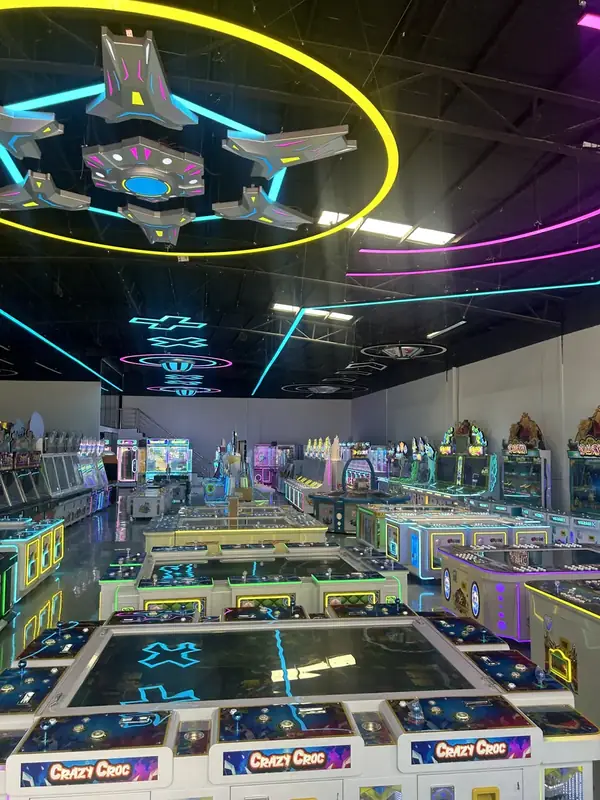
Steel frame, secured door, service access that does not require tools, and a screen size matched to the venue — 27" to 43" across upright and slant-top form factors. Route machines get moved, kicked and leaned on. A cabinet that flexes at the door seam is a service contract waiting to happen. Details live on the skill game cabinet page.
A Board With a Paper Trail
The control board decides whether your compliance story holds. Secure boot, signed firmware, revision control and a bill of materials a lab can trace — these are the features that matter at audit time, not the connector count. Our PCB design capability is in-house, which means the paper trail starts at schematic capture, not at a reseller's invoice.
Software With a Real Skill Element
The skill mechanic has to be genuine, measurable and documented — not a cosmetic button on top of a slot math model. Nudge windows, stop resolution and recall tasks all need math a regulator can read. The skill game software page covers how the engine, math models and per-market configuration work.
Per-Market Payout Framing
Ticket, voucher, redemption or card-based — the payout model is configured to what your jurisdiction licenses, and documented as such. One global build shipped everywhere is how operators end up in the news.
Reporting and Audit Trail
Every machine logs game events, door opens, firmware versions and payout totals in a format your compliance file can use. When a state asks what a machine did last quarter, the answer should come from the machine's own records — not from someone's memory. Ask every bidder to show a sample log before you compare prices; most cannot produce one, and that tells you the real ranking.
Specifications
Typical production configuration; every line is scoped per order.
- Form factors: upright, slant-top, bar-top; custom industrial design under OEM/ODM
- Display: 27" / 32" / 43" commercial-grade touch or button-panel configurations
- Control board: custom PCB, secure boot, signed firmware, tamper-evident logging
- Game library: nudge, skill-stop, pattern and recall titles; multi-game or single-game builds
- Math configuration: per-market win-curve and skill-window parameters, documented for audit
- Payout options: ticket printer, voucher, redemption, card system — per jurisdiction
- Power & environment: venue-duty PSU, 24/7 thermal design, surge protection
- MOQ: from 1 unit; trial batches standard
- Lead time: 12–42 working days by volume and customization
- Export record: 30+ countries served to date
Who Skill Game Machines Serve
The buyer profile is narrower than the search volume suggests, and that is deliberate on our side.
Licensed route operators run the largest fleets — bars, taverns, convenience and fraternal venues where a skill machine earns per-location. They need durable cabinets, fast spare parts and software that survives a regulator's visit. A route operator's worst week is not a slow bar; it is a machine impounded because the paperwork did not match the build.
Distributors buy white-label programs: their brand on the marquee, our engineering underneath, certification scoped to the states they serve. The distributor owns the customer relationship; we stay invisible behind it, which is the arrangement working distribution channels prefer.
Venue groups and arcades in permitting states mix skill titles with redemption and amusement product on one floor, so per-title reporting and a shared spare-parts pool matter more than any single game's earn.
What we do not serve: consumers, unlicensed operators, and "grey market" volume. If the license is not there, the quote is not either. Operators planning a U.S. entry should start with the state-by-state scoping on our skill-game solution page before pricing hardware.
OEM/ODM Programs
Our OEM/ODM services cover the full product surface, scoped per project from a single prototype to a multi-state rollout.
Cabinet and branding. Form factor, artwork, marquee, bezel and boot screen carry your identity. White-label programs leave no trace of the factory on the floor — the operator owns the brand relationship, we own the engineering behind it.
Game mix and math. Titles, nudge windows, skill-stop resolution and difficulty are configured to your market and player base. This is not a reskin exercise: the skill mechanic is tuned and documented as part of the build, because that documentation is what your license file needs.
How a program runs. Scoping call first — jurisdiction, license, venues, volume. Then a configuration document you sign before we build: cabinet spec, board revision, software load, payout frame, certification pathway. A prototype or trial batch follows, then volume. The sequence exists so that the machine a regulator inspects in month twelve is the machine described in the document from week two.
Board and platform. Custom I/O maps, peripheral sets and reporting formats are normal engineering scope. If you run your own venue-management stack, the machine reports into it; if you do not, ours is available.
Illustrative example, not a specific client. A regional distributor ordered a 20-cabinet trial in a white-label configuration — their brand, our board and software, payout framed to one state's licensed model. The trial ran two quarters. The reorder was 300 cabinets across three states, each with a state-specific software load. Because the board revision and the certification file stayed with one manufacturer, the two new states were documentation exercises, not re-engineering projects.
Compliance & Certification
Compliance is the product. Everything else is packaging.
The skill-game category is moving from tolerated grey zones toward licensed, taxed, documented operation — Pennsylvania's 2026 Supreme Court ruling is the loudest signal, and other states are watching. That shift is good news for operators who buy documented hardware and brutal news for anyone holding undocumented boxes. We build for the first group.
Our position, stated plainly: we are an equipment and software supplier — machines, boards and code — and licensing and compliance in your market are your responsibility. And certifications (GLI / BMM / CE) are scoped per market and per order — never implied as blanket approval. Our GLI certification capability prepares builds for independent lab review: auditable math, documentable RNG where the market requires it, and a bill of materials a certifier can trace. If a jurisdiction requires something we cannot honestly document, we say so at RFQ stage rather than after the container ships.
What lands in your file, per order: the build specification, the board revision record, the software load manifest, the math and skill-window documentation, the payout-frame configuration and the lab correspondence for the certification pathway chosen. When a licensing officer or a lab engineer asks a question, the answer is a document, not a phone call. That is the standard we hold ourselves to, and it is the standard your compliance counsel should demand from any bidder on your list.
For the market data behind this section — the ruling, the device counts, the tax framework — see our Pennsylvania skill games briefing.
Why GOLDPRIME: One Factory, Three Layers
Most "skill game suppliers" are integrators: they buy a cabinet here, a board there, license software from a third party, and hope the seams never show. The seams always show — at certification, at the first board failure, at the first regulator question.
GOLDPRIME GAME runs the layers in-house. Sheet metal, PCB, firmware and assembly sit under one roof, so a field fault traces to one engineering team instead of three vendors pointing at each other. Revision control means a spare board ordered in year three boots in a cabinet built in year one. And because the software team sits next to the line, per-market configuration is a production step, not a special request.
There is a second benefit nobody puts in a brochure: iteration speed. When a state tightens a definition — a narrower nudge window, a new reporting field, a different payout frame — an integrated factory responds with a board spin and a software build. An integrator responds with a supply-chain negotiation. Operators who lived through the Pennsylvania ruling cycle know which supplier they want on the phone when the next state moves.
We have exported to 30+ countries, with lead times of 12–42 working days and quotes in about 72 hours. The number that matters more: one accountable name on the whole build.
Spare Parts & Field Support
A route machine that sits dark for a week costs more than the part that failed. Every program ships with a recommended spare kit — power supply, button deck, display cable set and one control board per fleet block — sized so a field technician fixes the common faults on the first visit.
Because the board is ours, the spare is not a scavenger hunt. Revision control ties every shipped cabinet to a documented build, so a replacement ordered in year three matches the firmware the fleet already runs. The same applies to wear items: door hardware, locks, ticket paths and touch surfaces are catalogued parts, not "send us a photo and we will check." Distributors running white-label fleets get the parts list under their own program code, which keeps their service brand intact in front of their customers.
Support scope is set per contract: remote diagnostics where the market permits connectivity, advance replacement for boards under warranty, and escalation to the engineering team that designed the machine when a fault pattern appears. That last part is the real difference from an integrator — the people answering the escalation are the people who drew the schematic.
Skill Game Machines vs. Slot Machines
Buyers ask where the line sits. Operationally, three differences decide the purchase.
Outcome engine. A slot machine resolves on certified RNG alone; a skill game adds a player-input layer that can change the result. Regulatory category. Slots are gaming devices almost everywhere; skill games are classified state by state, which is why per-market software loads exist. Floor economics. Skill titles earn on engagement and repeat play in venues where slots are not licensed — bars, convenience and amusement floors.
If your license covers casino-style gaming, buy slot machines. If your market licenses skill or amusement formats, this page is your product family — and the four supporting pages on cabinet, board, software and the Pennsylvania market carry the detail.
Getting a Quote
Send the jurisdiction, the license type, the venue profile and the rough volume. We come back in about 72 hours with a scoped configuration — cabinet, board, software load, payout framing and the certification pathway — priced from 1 unit up. Request a quote or contact the team to start the scoping call.
The right skill game machines purchase reads like a compliance file that happens to include hardware. That is exactly how we build it.
Frequently Asked Questions
What are skill game machines?
Skill game machines are commercial gaming cabinets whose outcomes include a genuine player-skill element — nudge, skill-stop, pattern or memory play — rather than pure random chance. That distinction changes how regulators classify them in many U.S. states, and it changes what documentation a licensed operator needs from the manufacturer.
Who can buy skill game machines from GOLDPRIME GAME?
Operators, distributors and project buyers sourcing equipment for their target markets. We are an equipment and software supplier — machines, boards and code. Every order is scoped against the buyer's stated market and certification requirements before we quote hardware, software or certification; licensing in that market is the buyer's responsibility.
What is the difference between a skill game machine and a slot machine?
A slot machine resolves outcomes on a certified RNG alone. A skill game machine includes a player-input element — nudge timing, stop precision or recall — that can affect the result. The legal classification differs by state, which is why the math model and the paperwork must be built for your specific market.
Do you sell skill games for sale as complete cabinets or as kits?
Both. You can order complete floor-ready cabinets, a board-plus-software kit for your own enclosure, or a fully custom OEM/ODM program built to your spec. Most operators start with a trial batch of complete cabinets, prove the venues, then move volume once the floor economics are confirmed.
What is your MOQ for skill game machines?
MOQ starts from 1 unit — a single prototype or trial cabinet is a normal way to validate a market. Volume programs scale to full route or multi-venue rollouts. Lead time runs 12–42 working days depending on customization, and quotes come back in about 72 hours.
Are your skill game machines certified?
We build to a compliant-ready process and support GLI, BMM and CE pathways. Certifications are scoped per market and per order — never implied as blanket approval. Tell us your jurisdiction at RFQ stage and we design the build and the documentation around it.
Can you customize the games, cabinet and branding?
Yes. Cabinet form factor, artwork, marquee, game mix, math configuration and payout framing are all scoped per project. White-label programs carry your brand end to end, from the boot screen to the topper, with the underlying engineering and spare-parts chain staying with us.
Do skill game machines work in Pennsylvania?
Pennsylvania's 2026 Supreme Court ruling moved skill games toward regulation as gaming machines, with a legislative framework in progress. We supply equipment scoped to the framework as enacted; whether and how to operate under it is the operator's call with their counsel. See our Pennsylvania skill games page for the data.
How do skill game machines handle payouts?
Payout framing is configured per market: ticket, voucher, redemption or card-based systems depending on what the jurisdiction permits. We configure the machine to the licensed model and document it for the operator's compliance file. We do not configure machines to evade local law.