
Key Takeaways
- Coin-, token- and card-operated gaming machines classify under HS 9504.30 — not home-console codes.
- Correct classification drives duty, permits and inspection; a wrong code causes delays and fines.
- The 6-digit code is global, but what it triggers at the border is set by the destination market.
| Key Facts at a Glance | |
|---|---|
| HS 6-digit code | 9504.30 — games operated by coins, banknotes, bank cards, tokens or other means of payment |
| Defining test | Does the machine take payment to run a game? If yes, 9504.30 — not the home-console category |
| US HTS (10-digit) | 9504.30.00 — .10 video / .20 pinball / .40 other / .60 parts |
| Duty rate | Set by the destination country’s tariff schedule, not by the code itself |
When a container of gaming cabinets reaches the border, customs does not ask "how much?" first — it asks "what exactly is it?" The answer is a six-digit number: HS 9504.30.
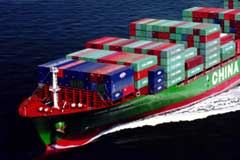 Freight is usually the biggest variable after the units themselves — the gaming machine shipping calculator models container loading and landed cost.
What HS 9504.30 Covers
The Harmonized System (HS) is the global standard for classifying traded goods. Coin-, token-, banknote- and card-operated gaming machines sit under Chapter 95 → 9504 → 9504.30, defined as "games operated by coins, banknotes, bank cards, tokens or other means of payment."
This covers:
- Arcade and video gaming terminals
- Digital slot / video-poker machines
- Pinball and bell-type machines
- Claw, crane and other coin-operated amusement units
Unfamiliar terms are all defined in the gaming machine glossary.
The defining test is simple: does the machine take payment to run a game? If yes, it belongs in 9504.30 — not in the home-console category.
Why Correct Classification Matters
Customs uses the HS code to decide:
- Which duty rate applies (set by the destination country, not the code itself)
- Whether import permits or certificates are required
- How the shipment is logged and inspected
A wrong code can trigger a re-assessment, a fine, or a hold while officials determine the true nature of the goods. Classification is the foundation every other clearance step builds on.
How the Code Subdivides
Most markets extend the 6-digit HS into longer national codes. For reference:
| Market | Subdivision example | Note |
|---|---|---|
| International (WCO) | 9504.30 | 6-digit base |
| United States (HTS) | 9504.30.00.10 video / .20 pinball / .40 other / .60 parts | 10-digit |
| China (export) | 9504.3010 electronic game machines / 9504.3090 other | 10-digit; indicative export rebate ~13%, MFN duty ~0% — varies by policy |
These figures are indicative and change with trade policy. Always confirm current rates with a licensed broker for your destination.
Declaration Data Elements You Must Supply
Classifying the goods under 9504.30 is only half of the filing. Export customs declarations also require a fixed set of product data elements that must match the commercial invoice exactly. For payment-operated gaming machines these are:
| Data element | What to declare |
|---|---|
| Brand type | OEM, ODM or own-brand — stated explicitly |
| Export preference status | Whether preferential tariff treatment is claimed (usually no) |
| Use | Commercial, coin-operated amusement and gaming |
| Category | Electronic game machine — video or other |
| Brand name | Declared as registered, including local and foreign spelling where applicable |
| GTIN / CAS | Barcode where one exists; CAS does not apply to machinery |
Machines are also declared by unit of quantity, not by weight alone, so the invoice must state how many complete units are in the shipment.
The most common filing error is collapsing a machine and its spares onto one line. A complete cabinet classifies as a machine, but replacement slot machine boards shipped separately are parts and take a parts subheading, so they belong on their own invoice lines before your broker files.
Work through the full paperwork sequence before the container leaves the factory with this export customs clearance checklist, which maps every document to the clearance step that consumes it.
Typical Documentation
To support the 9504.30 classification, keep on file:
- Commercial invoice with the HS code and an accurate product description
- Product description stating the payment mechanism (coin / token / card)
- Photos and specifications showing the cabinet and how it operates
- Packing list matching the invoice line items
Clear, consistent paperwork is what lets a broker defend the classification if questioned.
The specification those documents lean on comes from the build itself — the slot machine cabinet types, formats and measurements a broker will ask you to state on the invoice line.
Common Misclassification Pitfalls
Avoid these frequent errors:
- ❌ 9504.50 (home game consoles) — wrong; those lack a payment mechanism
- ❌ 8476.89 (vending / prize-dispensing machines) — only if the unit primarily sells goods; gaming machines are about the game experience
- ❌ 9503.00 (handheld electronic toys) — does not fit a commercial, coin-operated cabinet
Classification Meets Destination Rules
The HS code is universal, but what it triggers is local. The same 9504.30 machine may face different duties, certification checks and permit needs depending on the importing country. Where uncertainty exists, many operators request a binding advance ruling from the destination customs authority before shipping.
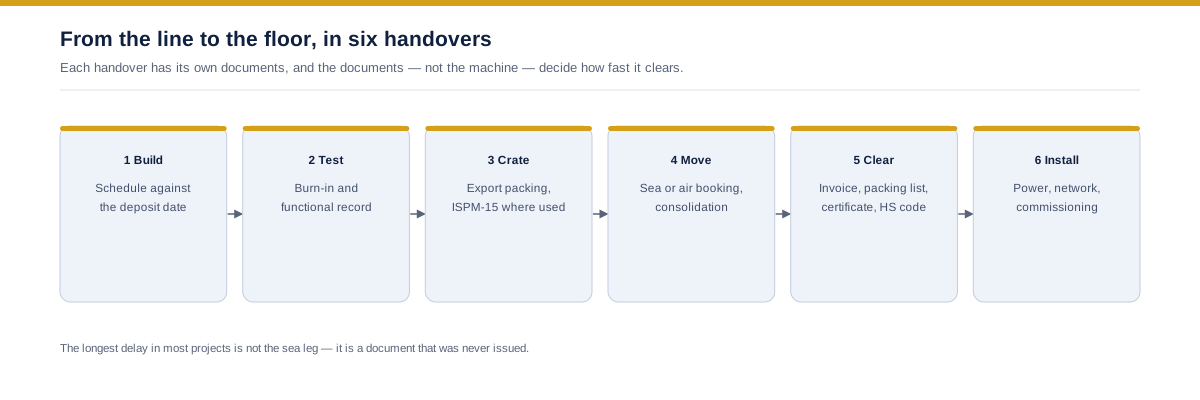
The physical side runs on the same calendar: stowage, packaging and vessel booking are planned alongside the paperwork — see how arcade cabinets are container-loaded and walk the full export and manufacturing process before the container leaves the factory.
Compliance note: Final classification, licensing and operation are the operator's responsibility in their market. GOLDPRIME GAME supplies accurate product descriptions and supporting documents; applicable certificates are available on request.
Who Holds Which Document, and What Is Redone Per Order
UL is one instrument in a wider file. The split below shows who prepares each document, who it is issued to, and what makes it be redone.
| Document | Prepared or issued by | Issued to | Redone when |
|---|---|---|---|
| Component certification evidence (power supply, acceptor, display, control board) | component makers and their test houses | the machine-level submission file | when the component revision changes |
| Technical file — schematics, BOM, build IDs | us | laboratory submission | when the build record changes |
| Math, RTP and RNG description | us | game approval | when the math model changes |
| Test report or type approval | an accredited laboratory (GLI, BMM or local) | the applicant | per market and per frozen configuration |
| Approval scope | the approval covers the model, the version and the jurisdiction named on it — nothing wider | the applicant, then the importer of record | any change to the math, the firmware build or the peripherals |
| Import conformity certificate | the importer's scheme — SABER, ECAS, INMETRO and NOM work this way | the importer, sometimes per shipment | per consignment |
| Operating licence | the operator and the regulator | the operator | not transferable with the hardware |
| CE declaration of conformity (EU) | the manufacturer — us on our own-brand machines, the brand owner on a white-label shipment | the machine file, the importer and the EU authorised representative | when the design, the components or the applicable directives change |
| Time and cost of certification | set by the laboratory and the destination scheme. Indicative planning ranges, not a quotation: Brazil INMETRO 12–28 weeks and USD 6,000–22,000 per product family plus an annual fee; Mexico NOM 6–14 weeks and USD 2,500–9,000 per family; Saudi SABER 8–20 weeks including testing scheduling and USD 400–1,600 per family plus a per-shipment certificate; Peru 15% of a UIT over about 15 working days; Malaysia 10 ringgit per model. The laboratory's schedule and your destination regime fix the actual figure | you, before a launch date is committed | every time the scope, the model or the market changes |
Where a compliance claim fails is usually at the handover, not at the test. Ask who signed the report, who holds the certificate, and whether the model named on it is the model being shipped. HS 9504.30 decides the duty and the permit route underneath all of it. With 20–30 days of production from a released order, the file and the build have to be planned on the same calendar.
The CE and GLI workflow is set out in CE and GLI certification.
FAQ
Q: Is 9504.30 the same in every country? A: The 6-digit base is standardized globally, but each country extends it into its own national code (e.g., the 10-digit HTS in the US). The base meaning stays consistent.
Q: Does the HS code set my duty rate? A: No. The code determines which rate applies; the actual rate is set by the destination country's tariff schedule.
Q: My machine also dispenses tickets — is that still 9504.30? A: Generally yes, if the primary function is a payment-operated game. Pure vending of goods would point elsewhere. When in doubt, request an advance ruling.
Q: What is the HS code for a slot machine? A: Payment-operated slot and video gaming machines classify under HS 9504.30. In the United States the 10-digit HTS extends it to 9504.30.00, with subheadings for video machines, pinball, other machines and parts.
Q: How do I declare a slot machine to US customs? A: Classify under the 10-digit HTS subheading, state the payment mechanism in the commercial-invoice description, and keep complete machines and separately shipped parts on distinct invoice lines — parts take their own subheading. A licensed broker files the entry, and CBP offers binding advance rulings when classification is uncertain.
Q: Does a correct HS code mean I can import the machine anywhere? A: No. Classification is only the first gate. Some markets restrict or even prohibit gambling-equipment imports regardless of the code — mainland China, for example, does not permit commercial casino-style machines to be imported for domestic operation. Always confirm permit requirements with your broker or the destination customs authority.
Q: Can GOLDPRIME GAME provide the documents I need? A: Yes. We supply commercial invoices, product specs and photos, and applicable certificates are available on request to support your broker's filing.
What to Look at Next
If the next question is the machine rather than the component, go to gaming machine OEM and slot machine manufacturer.
The resources center keeps the rest of the buying, logistics and compliance library in one place.