
Key Takeaways
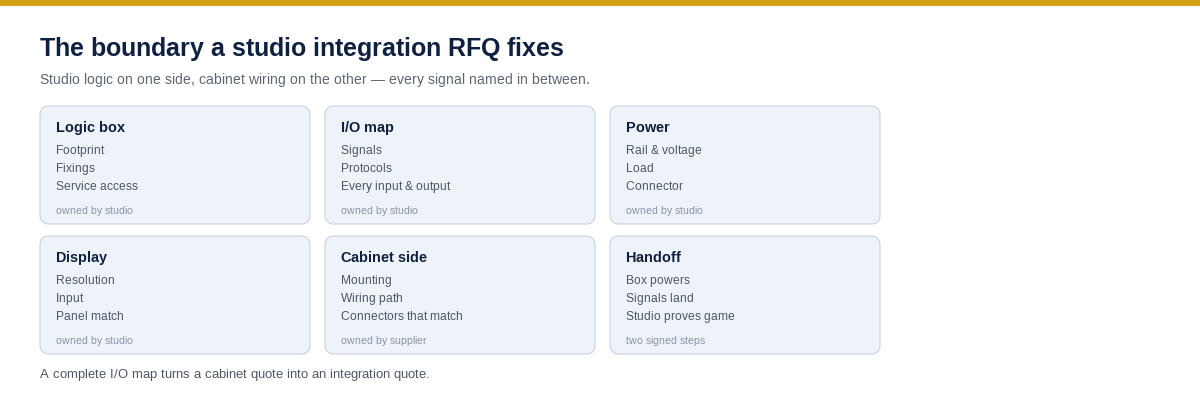
- The RFQ exists to fix the boundary: the studio owns the logic box and the game; the cabinet supplier owns the shell, power and wiring.
- The I/O map is the heart of the RFQ — every signal the logic box expects must be named.
- Acceptance is a handoff: the cabinet supplier proves the box powers and talks, then the studio proves the game runs.
Slot Cabinet Integration RFQ: The Purpose
The RFQ exists to fix one boundary: what the studio owns and what the cabinet supplier owns. Most integration failures are boundary failures.
- The studio owns the logic box, the game, the firmware and the signals they expect.
- The cabinet supplier owns the shell, the power, the display mounting and the wiring that carries the signals.
Write that split down, because an integration RFQ that leaves the boundary implied leaves every missing signal to be argued about later.
Logic Box and I/O Requirements
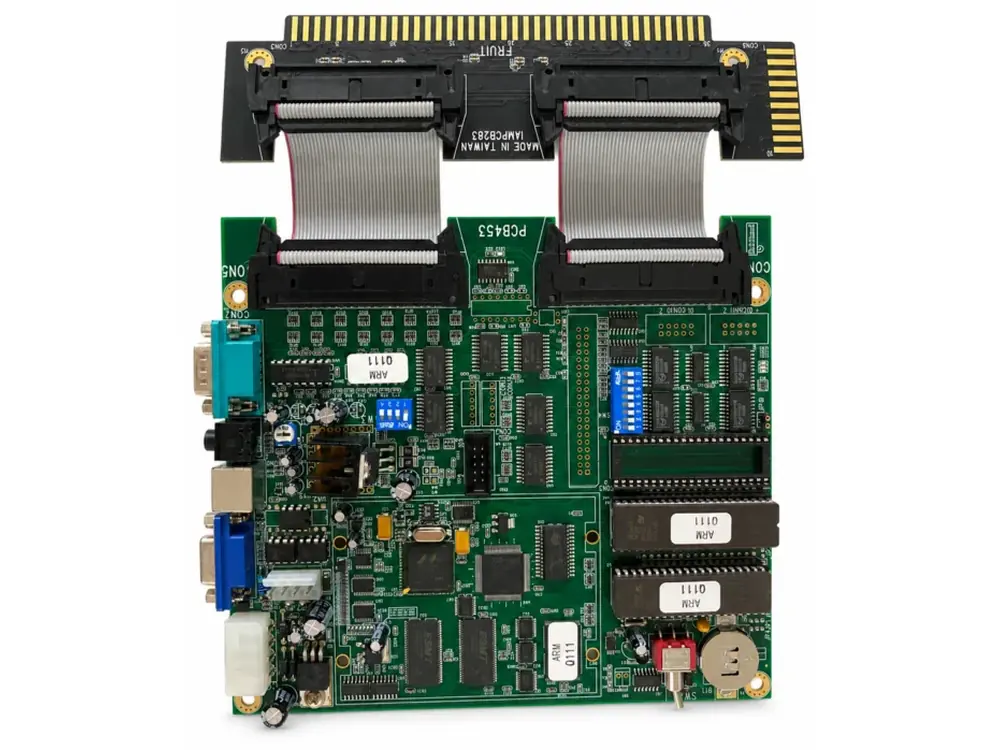
The I/O map is the heart of the RFQ. It names every signal the logic box expects, so the supplier can wire to it.
- Power: the rail, voltage and load the logic box needs, and the connector it uses.
- Signals: the inputs and outputs — buttons, meters, lighting, display — with their protocols.
- Display: resolution and input the box drives, and whether the cabinet's panel matches.
- Mounting: the footprint and fixings the box needs inside the cabinet.
A complete I/O map is what turns a cabinet quote into an integration quote. Without it, the supplier wires to a guess.
What the Game Studio Provides
The studio is not just the buyer; it is a supplier in the same integration. It provides the things the cabinet has to accept.
| Studio provides | Cabinet must accept |
|---|---|
| Logic box with footprint and fixings | A mounting position and access for service |
| I/O map with signals and protocols | A wiring path and connectors that match |
| Power requirement (rail, voltage, load) | A supply that holds the rail under load |
| Display resolution and input | A panel and harness that carry the signal |
The studio that sends a complete packet gets a quote it can compare. The studio that sends a board in a box gets an assumption with a price.
Acceptance and Handoff
Acceptance is a handoff in two steps, and each side signs its own step.
- Cabinet acceptance: the box powers, the rail holds, every signal in the I/O map lands where it should.
- Studio acceptance: the game boots, runs and talks to the peripherals on the supplier's cabinet.
Keep the two steps separate. A cabinet supplier cannot sign off a game it did not write, and a studio cannot sign off wiring it did not build — so the handoff record names who proved what.
FAQ
What is a slot cabinet integration RFQ for?
It fixes the boundary between a game studio and a cabinet supplier: the studio owns the logic box and the game, the supplier owns the shell, power and wiring. The RFQ names the split so nothing is implied.
What is the most important part of the RFQ?
The I/O map. It names every signal the logic box expects — power, buttons, meters, lighting, display — with their protocols, so the supplier wires to a spec instead of a guess.
What should the game studio provide?
The logic box with its footprint, the I/O map, the power requirement and the display resolution and input. A complete packet gets a comparable quote; a board in a box gets an assumption.
How is acceptance split between the two parties?
In two steps: the cabinet supplier proves the box powers and every signal lands, then the studio proves the game boots and runs. Each side signs its own step.
Why does the boundary need to be written down?
Because an implied boundary leaves every missing signal to be argued about later. Writing the split — studio logic on one side, cabinet wiring on the other — is what keeps the handoff clean.
Regulatory detail differs by jurisdiction and changes over time. Where a specification version or an effective date is named on this page, confirm it against the regulator's own publication before a build is released.
Integrate Your Logic Box into a Cabinet
Send the logic box footprint, the I/O map and the power requirement. The reply returns a cabinet quote that wires to your spec.
Request a Quote →