
Key Takeaways
- Accept the prototype in four groups: structure, wiring, peripherals and service access — in that order.
- A prototype is judged against a named drawing revision; an unnamed revision is an estimate, not an acceptance.
- Every out-of-tolerance result needs a disposition — fix, retest or waive — written down before mass production starts.
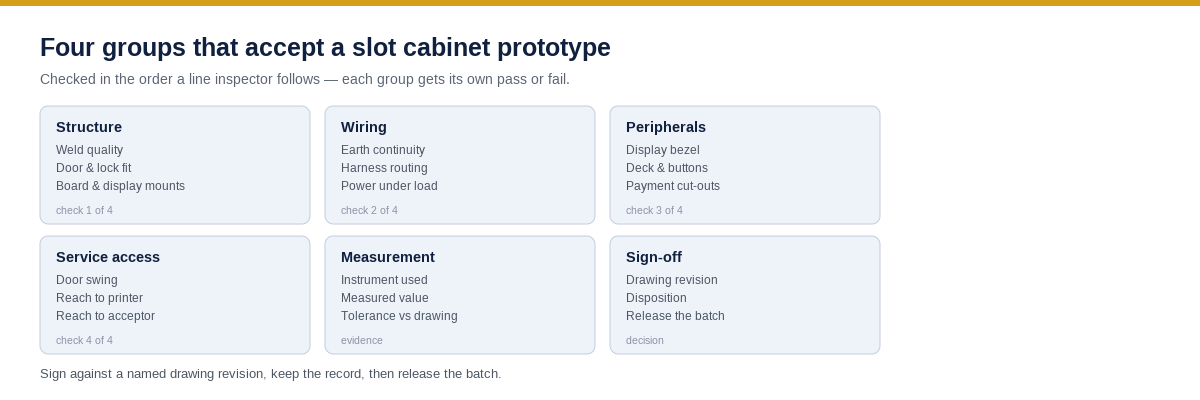

Slot Cabinet Prototype Acceptance: The Four Groups
Accept the prototype the way a line inspector does: four groups, in order, each with its own pass or fail.
- Structure. Weld quality, door alignment and swing, lock fit, and the mounting points that carry the board and display.
- Wiring. Harness routing, earth points, power rail and the connectors that mate with the board.
- Peripherals. Display bezel, deck, payment devices and any cut-outs they sit in.
- Service access. Whether the parts come out again for service — the check most prototypes fail.
Run the groups in order, because a structure problem makes every downstream measurement meaningless.
Wiring and Power Checks
Wiring is where two prototypes that look identical stop being identical. Three checks catch most of it.
- Earth continuity: every metal panel and the power supply earth to a single point, measured, not assumed.
- Harness routing: cables clear of hinges and sharp edges, with the bend radius the drawing calls for.
- Power under load: the rail holds its voltage with every peripheral switched on, not just on the bench.
A prototype that passes on the bench and fails on the floor usually fails here — a harness that rubs a hinge or an earth point that was never checked.
Peripheral Fit and Service Access
The peripherals decide the cut-outs, and the cut-outs decide the service posture. Check both together.
| Item | What to check | Why it fails later |
|---|---|---|
| Display bezel | Aperture against the panel, screw pattern | A 1 mm drift re-cuts the door for the whole batch |
| Deck | Button travel, harness strain | Buttons bind or the harness pulls out over time |
| Payment devices | Cut-out, note path, jam access | A tight note path is a service call, not an adjustment |
| Service access | Door swing, reach to printer and acceptor | What cannot be reached cannot be serviced |
Service access is the requirement most often discovered too late, because the prototype is checked on a bench with the door off.
What to Sign Before Mass Production
The sign-off is a written disposition, not a handshake. Three things belong on it.
- The drawing revision the prototype was measured against — unnamed, the acceptance is void.
- The measurement record: instrument, measured value, tolerance, pass or fail for each inspected dimension.
- The disposition: what happened to every out-of-tolerance result — fixed, retested, or waived and by whom.
Sign against the revision, keep the record, and only then release the batch. A sign-off without a revision is the most expensive kind of approval.
FAQ
What should a slot cabinet prototype acceptance cover?
Four groups, in order: structure (welds, door, locks, mounts), wiring (earth, harness, power under load), peripherals (bezel, deck, payment cut-outs) and service access (whether the parts come out again). Each group gets its own pass or fail.
Why does the drawing revision matter at acceptance?
Because the acceptance attaches to a named revision. A prototype measured against an unnamed drawing cannot be said to have passed, and a later drawing change quietly voids the whole acceptance.
What is the most common prototype failure?
Service access. The prototype is checked on a bench with the door off, so a printer or acceptor that cannot be reached in the field is discovered only after the batch ships.
What should I do with an out-of-tolerance result?
Write the disposition: fix and retest, or waive with a named authority and a reason. Never let it pass silently, because an undocumented deviation becomes the standard for the whole batch.
When can I release the batch?
After the sign-off names the drawing revision, the measurement record and the disposition of every failed item. Release before that and the batch inherits whatever the prototype did not prove.
Regulatory detail differs by jurisdiction and changes over time. Where a specification version or an effective date is named on this page, confirm it against the regulator's own publication before a build is released.
Get a Prototype That Is Ready to Sign
Send the drawing revision and your acceptance criteria. The reply separates structure, wiring, peripherals and service access, and names the record you will sign against.
Request a Quote →