
Key Takeaways
- Four measurements decide a base: footprint, hole pattern, top-face height and cable opening position. A fifth - anchoring - decides whether it stays put.
- Measure hole centres, never hole edges. Then measure one diagonal as a cross-check, because a pattern can be square on paper and a parallelogram in reality.
- Record the cabinet's loaded weight, not the catalogue weight. Ballast, bill hopper and glass change it.
- The cable opening has a direction. A base that fits but blocks the harness route is not compatible.
- Photograph the underside with a tape measure in frame. It answers more questions than a paragraph of description.
- Load ratings and anchoring requirements are verified against the specific model and the building, never assumed from a generic figure.
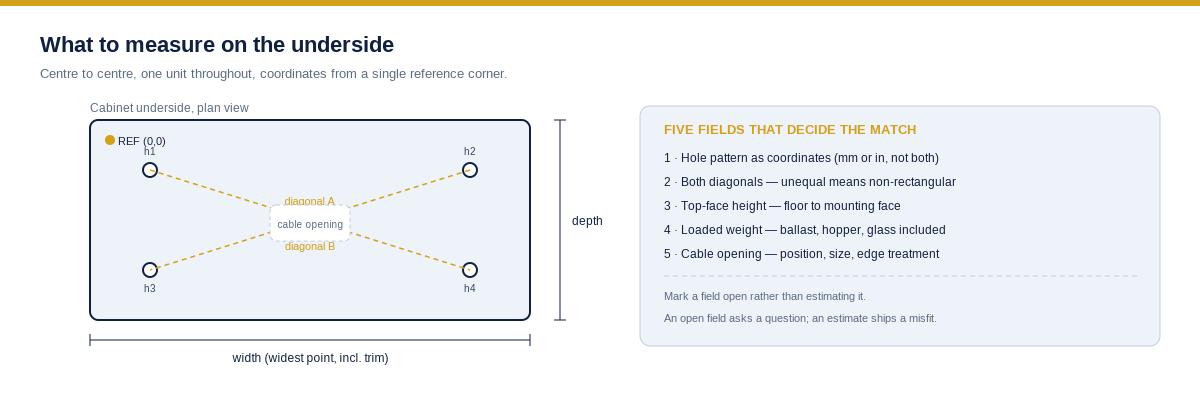
The measurement table in section four is the form to fill in. Take the photographs in section five at the same time; they are what a supplier actually needs to confirm a match.
Slot Machine Stands and Bases: Which One Are You Buying?
The same component is sold as a stand, a base, a plinth and a pedestal, and the word tells you which market the seller is in. Retail stands are built for home and vintage machines, usually in a small number of fixed sizes. A base supplied against a machine drawing is built to a pattern. A fixed-size stand has to be matched to your cabinet; a machined base has to be specified.
Two consequences for a buyer arriving from a search for a slot machine stand:
- Check what the stand is rated for. A home cabinet and a commercial cabinet with ballast, a full hopper and glass are different loads, and a stand sold for one may not be specified for the other.
- Check whether the top face is drilled or blank. A blank top means you drill it, which puts the hole pattern accuracy in your hands rather than the supplier's. For a commercial row, that is usually the wrong division of work.
Weighing the cabinet before you size the stand
The catalogue weight is rarely the weight that matters. Weigh one unit on a floor scale with ballast, hopper and glass in place, and record whether the reading was taken before or after. If weighing is impossible, ask the manufacturer for the as-configured weight and state the configuration in the enquiry - a weight without a configuration is a number for a machine that does not exist.
Record the dimensions the same way: overall height with the base fitted, not the cabinet alone. Two bases of the same footprint can differ in height by enough to change the ergonomics of a whole row.
Measure the Cabinet Footprint and Mounting Holes
Start from the underside of the cabinet with the machine on its side or on a lift, and measure in this order.
- Overall footprint. Width and depth at the widest point, including any protruding trim, handle or door stay. Note the shape - square, tapered or asymmetric - because a tapered cabinet needs a shaped base, not a rectangular one.
- Hole centres, both axes. Measure from centre to centre, not edge to edge. Record the pattern as a set of coordinates from one reference corner rather than as a list of pairwise distances, so it can be redrawn.
- Diagonal check. Measure corner to corner across the hole pattern. If the two diagonals differ, the pattern is not rectangular and a base drilled from the width and depth alone will not fit.
- Hole diameter and type. Threaded insert, through-hole, or slot. A slot tolerates adjustment; a through-hole does not.
- Base top-face height. The distance from the floor to the cabinet's mounting face. This sets the player height, and it is the measurement most often skipped - a base that fits the holes but raises the cabinet 40 mm changes the ergonomics of the entire row.
Record everything in millimetres or everything in inches, and state the unit on the form. Mixed units in a measurement sheet have produced more misfits than any other single error.
Confirm Load and Anchoring Requirements
Two questions: what the base must carry, and how it stays where it is put.
The load
Use the cabinet's loaded weight, not its shipping or catalogue figure. Ballast plates, a full bill hopper, glass and a coin mechanism all move the number. Then add the incidental loads that do not appear in a weight figure: a player leaning on the machine, a door being pulled open, a technician kneeling on the base during service. A base sized to the static weight and nothing else is sized for an empty room.
The anchoring
Anchoring depends on the floor and on the local requirement. A concrete slab, a raised access floor and a timber subfloor take different fixings, and a raised floor may need load spread rather than point fixing. Confirm the floor construction with the building, and confirm the fixation requirement with whoever inspects the site - this page gives no universal specification because the correct answer varies by building and by jurisdiction.
A practical test: ask the supplier what fixing the base is designed for and what happens if the site cannot accept that fixing. A base with one anchoring method and no alternative is a base that assumes your floor.
Check Cable Routing and Service Clearance
A base that fits mechanically can still fail operationally, in three ways.
- Cable opening position. Where the harness and power leave the cabinet, and where they need to arrive. A base with a central opening under an off-centre harness forces a re-route, and a re-route inside a base is a sharp bend or a chafed cable.
- Opening size and edge treatment. Enough room for the connector to pass, and a grommet or rolled edge so the cable is not cut by sheet metal over time. This is the failure that appears six months later, not on day one.
- Service direction. If technicians service from the front, the base should not obstruct the front skirt; if from the rear, the rear clearance must survive the base's footprint. Confirm the service direction before choosing a base shape, because a plinth wide enough to look stable can block the panel that opens.
Also check the floor interface: levelling feet versus castors. Castors change the working height and the stability, and a base specified for feet that arrives with castors changes both.
For the interface questions that sit above the base - display, harness and peripheral pairing - see the cabinet interface options and the cabinet compatibility overview.
Base Compatibility Checklist
Fill this in before enquiring. A supplier can confirm or reject a match from this table plus the photo set.
| Field | What to record | Why it decides the fit |
|---|---|---|
| Cabinet model and year | Manufacturer, model, approximate build year | Patterns change within a model line |
| Footprint | Width × depth at the widest point, with shape noted | Tapered and asymmetric cabinets need shaped bases |
| Hole pattern | Coordinates from one reference corner, centre to centre | Edge measurements cannot be redrawn |
| Diagonal | Both diagonals across the pattern | Detects a non-rectangular pattern |
| Hole type | Threaded, through-hole, slot; diameter | Determines fixings and adjustment range |
| Top-face height | Floor to mounting face | Sets player ergonomics for the row |
| Loaded weight | Cabinet with ballast, hopper and glass | Base load rating |
| Cable opening | Position, size, edge treatment | Prevents re-routing and chafing |
| Service direction | Front, rear or side | Rules out blocking plinths |
| Floor and fixing | Slab, raised floor or timber; required fixation | Anchoring method, verified on site |
| Feet or castors | Which is required, and the resulting height | Changes height and stability |
Where a field cannot be established, mark it open rather than estimating. An open field on the form produces a question; an estimated field produces a base that does not fit.
Photos to Send With the Enquiry
Five photographs, taken with a tape measure visible in the frame.
- Underside, straight on. The whole base area, with the hole pattern visible and a tape across the width.
- Underside, angled. Shows depth, brackets and any obstruction the straight shot hides.
- Hole close-up. One hole with the tape alongside, showing type and diameter.
- Cable exit. Where the harness leaves the cabinet, with the opening visible.
- Installed context. The machine in its row, showing service access and the neighbouring unit.
Send the photographs with the completed table rather than a description. "The standard base does not fit" is unanswerable; a table and five photographs are answerable in one reply.
FAQ
Can I use a base from a different cabinet model?
Only if the hole pattern, top-face height, cable opening and anchoring all match or can be adapted. The hole pattern is the usual blocker, and a pattern that differs by even one hole centre cannot be corrected without drilling, which changes the base's structural behaviour.
How do I measure a hole pattern correctly?
Measure centre to centre on both axes, record the results as coordinates from one reference corner, and then measure both diagonals as a cross-check. If the diagonals differ, the pattern is not rectangular and a base made from width and depth alone will not fit.
What weight should a base be rated for?
The loaded weight of the cabinet plus the incidental loads of use - a player leaning on the machine, a door being pulled, a technician kneeling during service. The catalogue weight is not the loaded weight once ballast, a full hopper and glass are included.
Why does base height matter if the holes line up?
Because it sets the player's working height for the whole row. A base that fits the holes but raises the cabinet changes reach, sightline and comfort, and in a mixed row it makes one machine sit differently from its neighbours. Height should be treated as a specification, not a by-product.
Does the base need a specific floor fixing?
It depends on the floor construction and on the local requirement. Concrete, raised access floor and timber subfloor take different fixings, and a raised floor may need load spreading. Confirm the floor with the building and the fixation requirement with the inspecting authority rather than relying on a general figure.