
Key Takeaways
- A VLT terminal RFQ separates the build into six lines; each line has an owner and a separate quote.
- Three buyers sit around the transaction — the authority, the operator and the venue — and the supplier's customer is usually one of the first two.
- Select a supplier on three gates: compliance (approved list), protocol (central link) and delivery (versioned build plus acceptance record).
- The regulator approves the terminal as a whole, so every peripheral and firmware change reopens the file.
VLT Terminal Procurement: The Three Buyers
VLT terminal procurement is unusual because the machine rarely sells to the room it sits in. Three parties sit around the transaction, and knowing which one is your customer decides how the RFQ is written.
- The lottery or gaming authority runs the network and often procures centrally, through a tender or an approved-supplier list. Its RFQ reads like a regulation: named standards, a submission process and acceptance criteria.
- The terminal operator or route company may own, lease or place machines under the authority's rules, and is the party that keeps them serviced. Its RFQ reads like an asset purchase: configuration, total cost of ownership and spares.
- The venue hosts the terminal and usually receives a share of revenue rather than owning the hardware. It appears in the RFQ mainly as a constraint — floor space, power and service access.
The practical consequence is that a VLT RFQ is judged against a document the supplier does not control. The build is signed off against a named version of a named specification, and a version change means a re-check.
The VLT Terminal RFQ: Six Lines, Six Owners
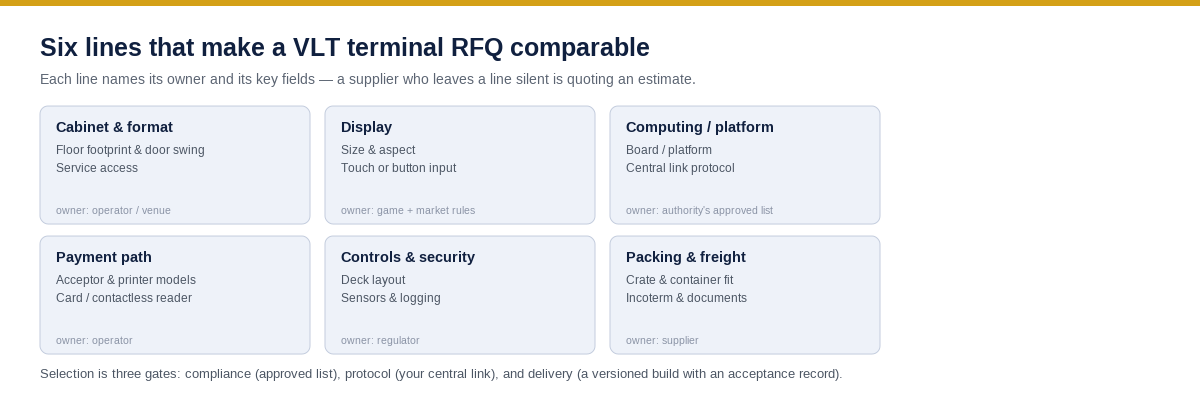
A comparable quote separates the terminal into six lines. The mistake most buyers make is asking for one machine price, which lets each supplier choose which line the number includes.
| Line | What it holds | Who fills it | What changes the build |
|---|---|---|---|
| 1. Cabinet & format | Steel shell, door, locks, service access, mounting | Operator / venue | Floor footprint, door swing, wall-mount structure |
| 2. Display | Panel size and aspect, touch or button input, bezel | Game design + market rules | Larger or dual screen re-cuts the door and bezel |
| 3. Computing / platform | Board, OS, firmware, central-system link | Authority's approved list | Any platform change reopens testing |
| 4. Payment path | Acceptor, ticket printer, card and contactless reader | Operator | Peripheral model drives cut-outs, harness and power |
| 5. Controls & security | Deck layout, button set, sensors, access log | Regulator | Logging requirements the terminal must expose |
| 6. Packing & freight | Crate, pallet, container fit, documents | Supplier | Volume, destination, Incoterm |
Where the design is not final, send the model with the open items listed. A supplier can quote around open items; it cannot quote around silence.
Supplier Selection for VLT Terminals
Supplier selection for a VLT terminal is a three-gate exercise, and the gates are checked in order.
- Compliance. Is the supplier on the authority's approved list, or able to pass the technical submission? If not, every other answer is moot.
- Protocol. Can the terminal link to your central system — registering, heartbeating and recovering from a dropped connection the way the programme expects? This is the line a cabinet supplier most often cannot meet.
- Delivery. Can the supplier hold a versioned build and produce an acceptance record that names exactly what ran? A supplier who cannot is quoting a cabinet, not a terminal.
Ask the supplier to describe these three, not just the machine. A supplier who can name the owner of each line and the evidence behind each gate is describing a process; one who says "we can build it" is describing an intention.
Platform and Peripheral Responsibilities
Two lines decide most of the risk in a VLT terminal procurement, and both should be written as responsibilities rather than left as assumptions.
The platform — board, firmware and central link — is normally named by the authority's approved list, and it is the line that most tightly binds the terminal to the programme. A terminal sourced from a supplier whose platform is not on that list is a cabinet, not an approved terminal.
The peripherals — acceptor, printer and reader — are chosen by the operator within approved models, and they carry their own cut-outs, harness and power budget. State them by model and revision in the RFQ specification, because a peripheral swap after approval reopens the file.
The division of labour belongs in writing: who supplies the platform, who supplies the peripherals, and who is responsible when a submitted configuration fails testing. Leaving any of these unnamed turns a clear build into a negotiation at acceptance time.
Copyable Procurement Checklist
Copy this into the enquiry. Mark each line present, absent or not applicable, and name the owner beside it.
| Block | Item |
|---|---|
| All lines | Destination jurisdiction and programme name |
| All lines | Central system protocol and version |
| All lines | Quantity per configuration and repeat volume |
| Cabinet & format | Format (floor, bar-top, wall-mount) and service-access requirements |
| Display | Size, aspect, touch or button input |
| Computing | Board or platform from the approved list, firmware revision |
| Payment path | Acceptor, printer and reader models with revisions |
| Controls & security | Deck layout, sensors and logging requirements |
| Packing & freight | Destination, Incoterm and required documents |
| Acceptance | Acceptance record format and the tests it must name |
Closing the Loop on Acceptance
Quote and acceptance are the two ends of a VLT terminal procurement, and they fail for the same reason: the quote did not name what the acceptance would later check.
A quote should return six lines, each priced alone, with the owner and the assumptions listed beside it. An acceptance should return a record that names exactly what ran — board and firmware revisions, peripheral models, the central-link test, the payment-path test and the control test, each with a pass or fail result.
A record that lists two functions is evidence for two functions; a record that lists nothing is a photograph. Agree the record format before the first build, because a record produced after a reject is a negotiation document rather than an acceptance.
FAQ
Who buys video lottery terminals — the venue, the operator, or the authority?
Usually the authority or a licensed operator, not the venue. The authority often procures centrally through a tender or an approved-supplier list; a terminal operator may buy or lease and place the machines; the venue hosts them and takes a revenue share.
What belongs in a VLT terminal RFQ?
Six lines, each with an owner: cabinet and format, display, computing and platform, payment path, controls and security, and packing and freight. Also name the destination jurisdiction, the central system protocol and the quantity per configuration, because a quote without those cannot be compared.
How do you compare two VLT terminal suppliers?
On three gates. Compliance: is the supplier on the authority's approved list, or able to pass the technical submission? Protocol: can the terminal link to your central system? Delivery: can the supplier hold a versioned build and produce an acceptance record? A supplier who cannot answer all three is quoting a cabinet, not a terminal.
Does the regulator approve the terminal as a whole?
Yes, as a configuration — hardware, firmware and game build together. A cabinet that matches on the outside can fail on paper, because the approved configuration is version-specific and a changed board, display or peripheral model usually reopens the file.
What should the acceptance record contain?
Exactly what ran: the board and firmware revisions, the peripheral models, the central-link test, the payment-path test and the control test, each with a pass or fail result. A record that lists nothing is a photograph, not an acceptance.
Regulatory detail differs by jurisdiction and changes over time. Where a specification version or an effective date is named on this page, confirm it against the regulator's own publication before a build is released.
Scope a VLT Terminal Build for Your Market
Send the jurisdiction and programme, the central system you must connect to, the cabinet format and the payment devices you intend to use. The reply separates the six lines and names the evidence your submission will need.
Request a Terminal Quote →