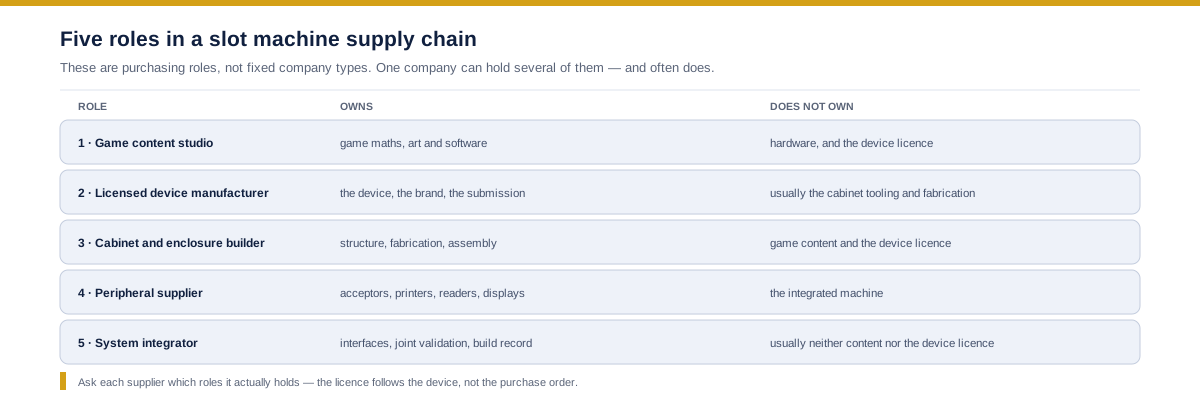
Key Takeaways
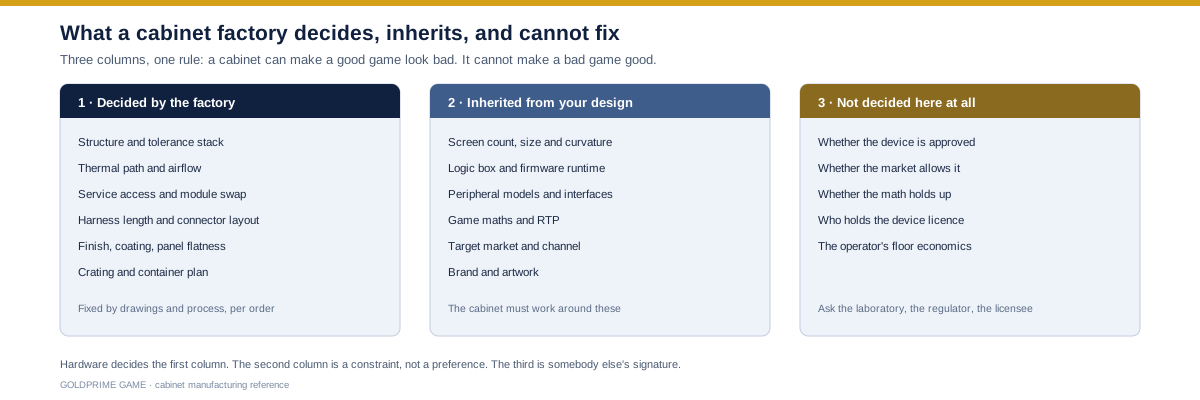
- A slot cabinet manufacturer decides six things and inherits six others, and projects slip when a buyer assumes the factory owns both lists.
- Thermal design is the specification that never reaches the brochure, and the only honest way to judge it is a temperature record at your configuration.
- Peripheral compatibility breaks at three separate layers, and each layer has a different owner.
- Moving from ODM to OEM is a handover of six artefacts, not a change of supplier.
- No cabinet fixes weak maths, a failed certification or a missing market approval.
What Does a Slot Cabinet Manufacturer Actually Control?
Six things, and no more: the structural design and its tolerance stack, the thermal path, the service access, the harness and connector layout, the finish and panel flatness, and the way the unit is packed. Everything else on a slot machine — the screens, the logic box, the peripheral models, the game maths, the target market and the artwork — arrives as a constraint from the buyer's design. The distinction sounds academic until a project slips, and then it turns out nobody had agreed which column a decision sat in.
That split is the reason two suppliers can quote the same cabinet and mean different things. It is also why the first useful question to any cabinet partner is not "can you build this" but "which of these six do you own the evidence for". The role boundaries behind the question are set out in the value chain reference, which separates component evidence, the submitted build and market approval.
What Can a New Cabinet Not Fix?
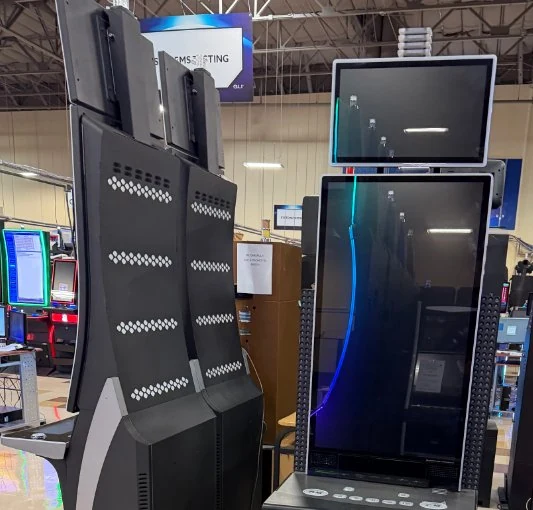
A new cabinet cannot lift a weak maths model into a good game. Return to player, hit frequency, volatility and the shape of the pay distribution are set by the mathematics and the game program, not by the enclosure. A cabinet changes how a player reaches the game, how clearly it reads across a floor, and how quickly a technician can get it back into service. It does not change what the maths pays out over a million spins.
Three more things sit firmly outside the cabinet's control. Certification is a laboratory's verdict on a submitted configuration against the standard your market has adopted — the cabinet affects whether the device can be measured cleanly, not whether it passes. Market approval is issued by a regulator to an applicant, and no factory signature substitutes for it. The device licence belongs to the company whose name is on the machine.
So the honest version of the sales claim is narrower than it usually sounds: a good cabinet makes a good game look and feel good, and keeps it earning. A poor one makes a good game look broken. Neither direction rewrites the paytable.

How Do You Judge Thermal Design Before You Order?
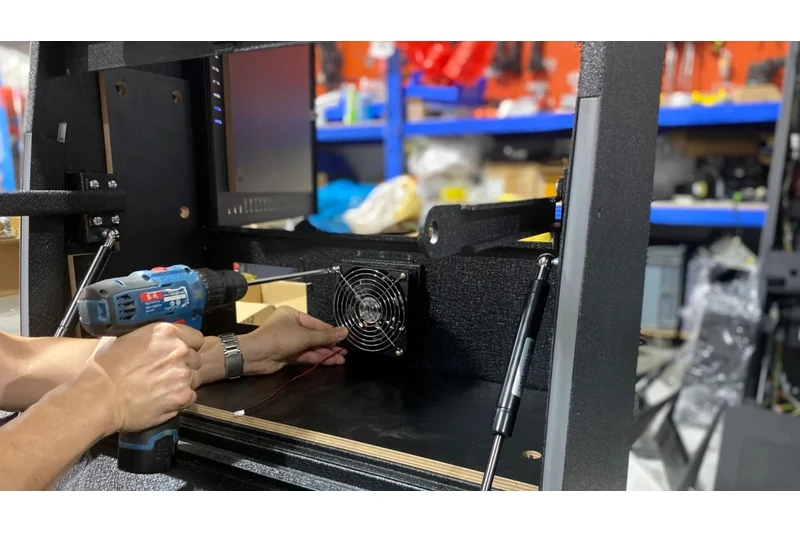
Start by accepting that no catalogue number will answer it. Heat load in a sealed cabinet comes from the displays (brightness multiplied by area), the compute module, the power supply and every peripheral that draws current, and the same enclosure behaves differently at 24 inches and at 86 inches, in a 22 °C showroom and a 35 °C floor with a loaded intake filter. Any single temperature figure quoted without a configuration is decoration.
What can be judged is the design logic. Ask where air enters and where it leaves, and what happens to that path when the filter loads. Ask which points are measured, at what ambient, and at full peripheral load rather than on a bare bench. Ask whether fans are on a fixed curve or a controlled one, and whether a cabinet air-conditioner is an option or a retrofit. Ask how often the filter needs changing and whether a technician can reach it without opening the electronics bay.
The evidence that settles it is a temperature-rise record taken on a unit built to your configuration. Ask for that specific record. A partner who can produce it has done the work; a partner who answers with a datasheet has not measured anything. The safety frame around the same assembly matters here too: in North America the machinery standards are UL 62368-1 for the assembly and UL 22 for the complete cabinet, in the EU EN IEC 62368-1 with EN 55032 and EN 55035 for emissions and immunity, and FCC Part 15 in the United States. Thermal failure and EMC failure are often the same design margin failing twice.
What Decides Whether the Cabinet Survives a Casino Floor?
Not steel thickness on its own. A cabinet survives on how its tolerance stack is resolved at the joints, how the hinges and locks are specified, whether modules can be swapped as units or only as parts, whether the harness is strain-relieved where it bends, and whether panels stay flat after coating. A heavy enclosure with a poorly resolved door can loosen faster than a lighter one designed around the same vibration.
Service access is the second half of durability, and it is where the money actually moves. Downtime on a live floor costs far more per hour than the material difference between two cabinet designs, so front access, a module tray, and a repair that needs one tool instead of six are not premium features — they are the part of the price that pays itself back. The fabrication discipline behind those tolerances is covered in gaming cabinet sheet metal, and the approval gates that fix a build before volume in the manufacturing and acceptance process.
Where Do Peripheral Compatibility Claims Break?
At three layers, and buyers usually test only the first. The mechanical layer is the cutout, the bracket and the depth available behind the panel — a validator that fits the hole may not clear the cable bend. The electrical layer is voltage, current draw and connector type, including the polarity conventions that vary between models. The protocol layer is what the device speaks: pulse for the legacy acceptor, serial for the printer, MDB for the peripheral bus, SAS or G2S for the host link, and TITO as a business workflow sitting on top of all of it.
Named hardware is worth naming, because the names are where the claims get tested. Bill validators and coin handling from ICT, JCM, ITL and MEI, touch assemblies from 3M and GP58, boards from the FORMOSA, ALICE and RED BOARD families. A supplier that has fitted a specific model at a specific interface can say so precisely. A supplier that says "compatible with brand X" has said almost nothing, because the useful sentence always ends with the model number and the interface.
Three pages go deeper than this one can: cabinet interface options covers the mechanical and harness choices, MDB and payment peripherals separates the device bus from the host link, and slot cabinet compatibility deals with what "IGT compatible" or "Aristocrat compatible" can and cannot mean.
When Should You Move a Cabinet Design from ODM to OEM?
Most programmes start the other way round: the first generation is built on an established platform under an ODM arrangement, because a new brand needs a machine on a floor before it needs proprietary tooling. The switch to OEM becomes worth doing when the cabinet itself starts carrying the brand — when the silhouette, the deck geometry or the service architecture is the thing customers recognise, and when a second source or a market requirement makes holding the drawings necessary rather than nice to have.
What moves across the line is not a relationship, it is six artefacts: the drawings and 3D, the tooling and fixtures, the tolerance baseline the parts are inspected against, the BOM and its change control, the first-article process, and the packaging plan. Miss any one of them and the switch costs more than it saved — usually a quarter, usually discovered when the first volume batch is measured against a sheet nobody agreed.
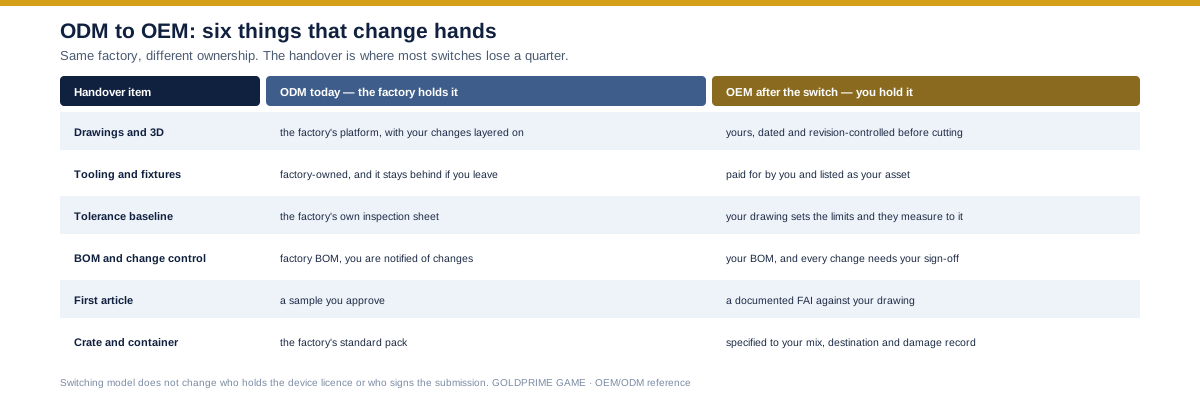
Two things do not move with the drawings. The device licence stays with the licensed party, and the submission stays with the applicant. And if the switch changes the structure or the electrical architecture rather than only its ownership, the certification scope can change with it — which is a planning question to settle before the tooling is paid for, not after. The service-side view of the same choice, including what a buyer should bring to the first conversation, is on choosing your gaming hardware service scope; the program-level view of brief, prototype and volume is on gaming machine OEM.
What Should You Ask Before Signing a Cabinet Manufacturing Contract?
Eight questions, each of which has a wrong answer that costs real money later.
Does the quote cover the cabinet or the complete machine?
These are different scopes with different price structures. A cabinet-only quote covers structure, finish, harness and packing. An assembled-machine quote adds the logic box, displays, peripherals, firmware load and the burn-in that goes with them. Ask which one you are holding, because comparing a cabinet price against a machine price is the most common way a budget goes wrong at week six.
Which tolerance sheet will you inspect against?
Ask for the document itself, not the word "standard". It should name the dimensions that matter — panel flatness, hole positions for the deck and validator, door gap, diagonal — and the limits applied to each. If the sheet is the factory's own and never references your drawing, you are buying their interpretation of your design.
What is the first-article process, and who signs it?
A first article is a documented inspection of the first unit against the drawing, with measured values rather than a yes. Ask who performs it, who signs it, and what happens to the production units if the first article shows a deviation. A sample you eyeball is not a first article.
Who owns the drawings and the tooling if we stop?
Settle this in writing before the first cut. Drawings you paid to develop, tooling you paid to make, and fixtures built specifically for your geometry should be listed as your assets and be returnable. Without that clause, switching supplier later means re-engineering from photographs.
What happens if a specified peripheral is discontinued?
Peripheral models age out faster than cabinets do. Ask for the substitution process: who proposes the alternative, who re-tests the interface, and whether the change triggers a documentation update. A supplier with no answer will fit whatever is in stock and tell you afterwards.
How is a change request priced, and how long does it take?
After the configuration freeze, every change has a cost and a schedule effect. Ask for the mechanism while the mood is good: how a change is quoted, whether it re-opens the frozen BOM, and whether it moves the delivery date. The point is not to negotiate the price of a change now, it is to know the price of one later.
What documentation ships with each unit?
Ask for the list: build record, inspection sheet, burn-in log, firmware version at packing, and the conformity documents the destination market requires. This is the file an inspector or a laboratory will ask for, and reconstructing it after the container has sailed is not a thing that can be done.
What is the acceptance test, and where does it happen?
Factory acceptance testing happens at the plant, against a locked configuration, before packing — and it is a checkpoint, not a guarantee of site performance or of regulatory approval. Ask what is tested, what is recorded, and who signs off. Market-level requirements and the submission route are a separate question, mapped in compliance pathways for gaming machines.
What Should You Read Next?
If the decision in front of you is the cabinet itself, start with the slot machine cabinet range — 38 models across 10–49 inch screens in flat, curved and touch formats, with the spec table for each. If the decision is who builds it, the gaming machine OEM page covers the programme from brief to volume. If the question is whether the whole build matches your market, compatibility and compliance answer different halves of it, and if you would rather put the question directly, send the configuration and the destination market.
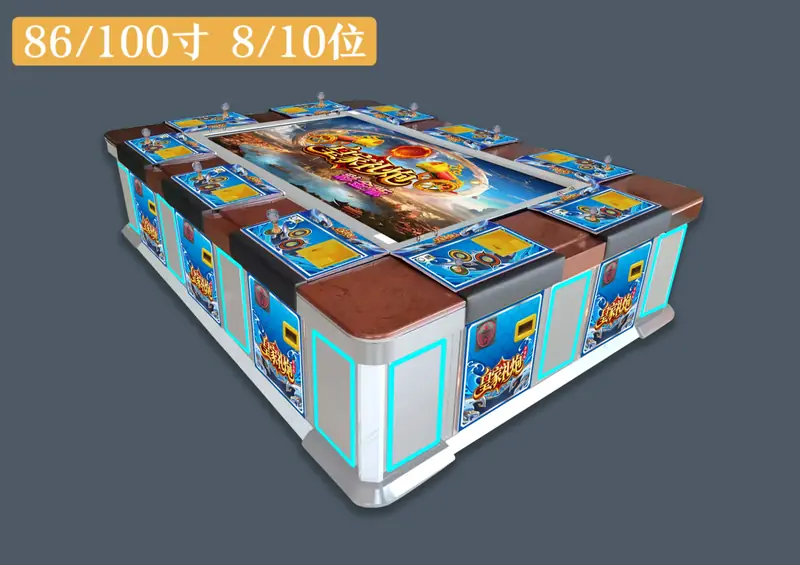
How to Choose a Commercial Fish Game Cabinet (2026 Guide)
Seven steps through venue, player count, payment configuration, build quality and compliance for fish game cabinets.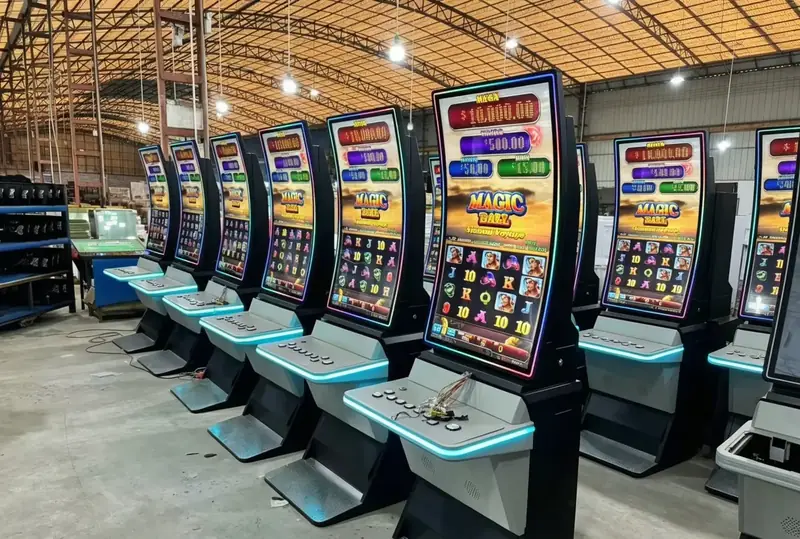
Slot Machine Buyer Segments: Matching Machines to Buyer Types
Five buyer segments and how each maps to a machine mix before price enters the conversation.