
Key Takeaways
- "Prewired" is a supplier-specific word. Ask for the component list, not the label.
- An empty cabinet normally includes structure, finish, display mounting, locks and base interface - and normally excludes power supply, harness, controls, payment peripherals and board.
- The decision hinge is your existing board: its mounting pattern, display output, power draw and protocol determine how much of the prewired set you can actually use.
- Compare the same cabinet in both configurations, never two different cabinets.
- Three columns stop most disputes: included, optional, customer-supplied. A line with no column is a line that will be argued about.
- Assembly and test responsibility must be named even when the parts are all supplied - especially then.
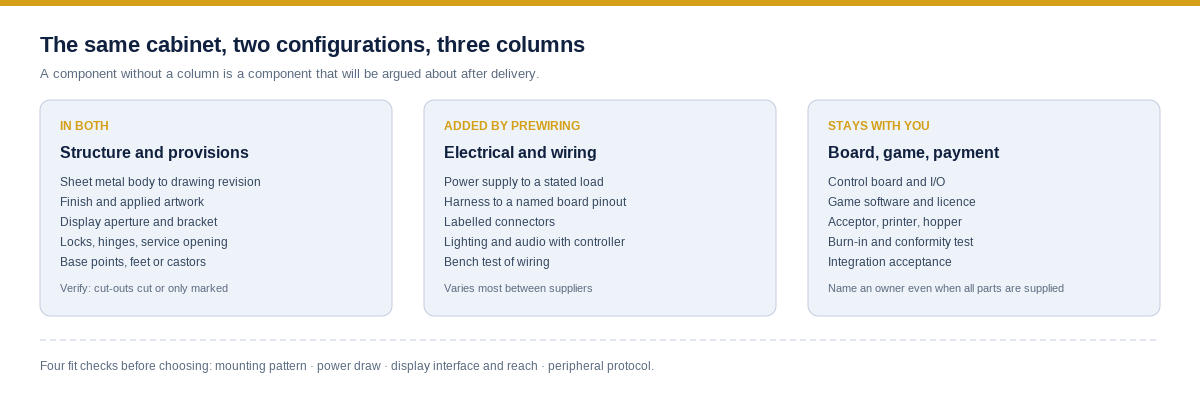
The comparison table in section three is the artifact to take to a supplier. Everything above it explains why the three-column format is worth insisting on.
What Is Included in an Empty Cabinet?
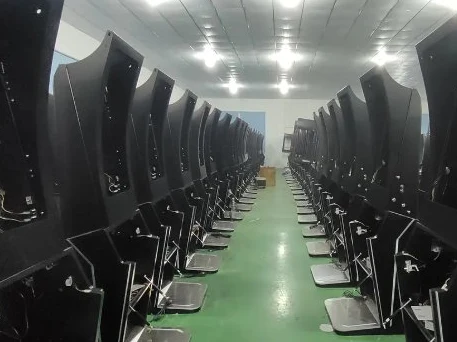
An empty cabinet is a finished structure with provisions for hardware, not a partly built machine. What it typically carries:
- Structure and sheet metal - body, door, panel seams, mounting plates and internal brackets to the drawing revision
- Finish and graphics - powder coat or paint, printed panels or artwork application, edge treatment
- Display mounting - the aperture, bracket pattern and bezel for the specified screen size
- Access hardware - locks, hinges, door stays, and the service opening arrangement
- Base and transport interface - castors or levelling feet, base mounting points, lifting provisions
- Provision for peripherals - cut-outs, bezels and mounting positions for acceptor, printer or hopper, which may be cut or may be marked only
What it typically does not carry: power supply and distribution, harness, control board or I/O, payment peripherals, the game board itself, and any test or conformity work. Those are the five lines that turn an empty cabinet into a machine, and each one can be priced and owned separately.
Two details cause most of the friction. First, whether peripheral cut-outs are actually cut or merely marked - a marked panel needs fabrication work later, and that work is usually charged at one-off rates. Second, whether the display bracket matches the screen you intend to buy, because a bracket for a different depth or VESA pattern is a metal rework, not an adjustment.
What Does Prewired Include?
Prewired usually means the cabinet is wired to accept hardware: harness installed, power distribution present, connectors terminated and labelled. Where it stops varies, and the variation is the problem.
| Item | Commonly in a prewired build | Commonly still excluded |
|---|---|---|
| Power supply and distribution | Yes, sized to a stated peripheral load | Upgrades for extra peripherals beyond the stated load |
| Harness | Yes, to a named board pinout | Harness for a board not in the original scope |
| Lighting and audio | Often yes, with a controller | Custom lighting sequences tied to game events |
| Payment peripherals | Sometimes, if named in the quote | Frequently excluded - bill acceptor and printer are separate lines |
| Board and game | Rarely | Almost always customer-supplied or licensed separately |
| Assembly and test | Bench test of wiring, sometimes a power-on check | Full game-level test, burn-in and conformity testing |
The harness detail deserves emphasis. A prewired cabinet is wired to a pinout, and the pinout belongs to a board. If you later fit a different board, the harness may need re-termination, and the labelling convention may no longer match. Ask for the pinout document at quotation stage; if the supplier cannot produce one, the cabinet is wired by habit rather than to a specification.
Compare the Same Cabinet in Both Configurations
Comparing an empty cabinet from one supplier with a prewired cabinet from another compares two products and teaches nothing. Use one cabinet form, write it as a BOM (bill of materials), and list every component against three columns.
| Component | Empty | Prewired | Who supplies if excluded |
|---|---|---|---|
| Structure, finish, artwork | Included | Included | - |
| Display mounting and bezel | Included | Included | - |
| Locks and service access | Included | Included | - |
| Power supply and distribution | Customer-supplied | Included to stated load | Buyer, or added as an option |
| Harness and labelling | Customer-supplied | Included to named pinout | Buyer, against supplier's pinout |
| Lighting and audio | Optional | Included | Buyer, or option line |
| Control board and I/O | Customer-supplied | Customer-supplied | Buyer, or licensed separately |
| Bill acceptor, printer, hopper | Customer-supplied | Optional, must be named | Buyer, or option line per peripheral |
| Board and game software | Customer-supplied | Customer-supplied | Buyer |
| Assembly and bench test | Not included | Included, scope stated | Buyer's integrator |
| Burn-in and conformity test | Not included | Usually excluded | Buyer, or a separate project |
Fill this in for one cabinet form and the price difference becomes explainable line by line. Suppliers who resist the three-column format are usually protecting a lump sum, and a lump sum is exactly what prevents you from seeing whether the prewired premium buys harness labour, peripherals, or nothing at all.
Which Option Fits Your Existing Board?
Four checks decide it, and all four can be answered before payment.
- Mounting and aperture. Board dimensions, mounting hole pattern, and whether the board expects to sit on a plate, a tray or standoffs. A prewired cabinet built for a different board family may still accept yours mechanically and then fail electrically.
- Power. Board input voltage and current draw, plus the peripherals you intend to run. Compare against the stated load of the prewired distribution, not against the supply's peak rating.
- Display and interface. Screen size, resolution, connector type and cable length. A prewired harness built for one display standard may not reach or match another.
- Protocol and peripherals. Whether the board talks MDB, a serial protocol or a proprietary bus, and whether the acceptor and printer you plan to fit speak the same language. The interface options overview covers the pairing rules; the MDB peripheral note covers the payment side specifically.
If all four match, prewired saves integration labour and removes a class of wiring error. If one or more do not match, the prewired premium buys you a harness you will re-terminate - and an empty cabinet with your own harness is the cleaner purchase.
What to Put in the RFQ
State the configuration as a component list, not as a word.
- Cabinet form and drawing revision, plus the artwork files and finish specification.
- Configuration requested: empty, prewired, or prewired with named peripherals - and which components you supply.
- Board details if you have them: model, dimensions, mounting pattern, input power, display output, protocol.
- Peripheral list with models and protocols, including acceptor, printer, hopper or payout mechanism.
- Assembly and test scope: who assembles, who powers up, who signs the test sheet.
- Quantity per configuration, and whether a sample unit is expected before the batch.
- Destination market, so conformity scope is raised early rather than after the build.
Ask for the reply as the same three-column table. A supplier who returns your table filled in has understood the request; one who returns a price and a brochure has answered a different question.
FAQ
Is a prewired cabinet the same as a complete machine?
No. A prewired cabinet is wired to accept hardware; a complete machine includes a board, game software, payment peripherals and a tested configuration. The gap between the two is where board supply, peripheral supply and test responsibility sit.
Can I fit my own board into a prewired cabinet?
Usually yes if four checks pass: mounting pattern and aperture, power draw against the stated load, display interface and cable reach, and peripheral protocol. If the harness was built to a different pinout, it will need re-termination, which is why asking for the pinout document at quotation stage matters.
Are peripheral cut-outs cut or just marked on an empty cabinet?
Both are common and the difference is a cost. Ask explicitly whether the acceptor, printer and hopper cut-outs are cut to the specified bezel or marked only. Marked panels require later fabrication, usually at one-off rates rather than batch rates.
Who tests a prewired cabinet?
Whoever the scope says. Typically the cabinet supplier bench-tests wiring and may power the unit on, while game-level testing, burn-in and conformity testing remain outside. Name the party and the acceptance document for each, because a powered-on check is not a game-level test.
Which is cheaper, empty or prewired?
Prewired is cheaper per unit when you would otherwise pay for harness labour, connector sourcing and integration time, and when your board matches the pinout. Empty is cheaper when your board or peripherals differ from the prewired specification, because you would be paying for wiring you have to redo.