
Key Takeaways
- Model payback as CAPEX ÷ monthly net operating income — a planning tool, not a promise.
- CAPEX is machines + fit-out + systems; budget a contingency for the costs owners forget.
- Track revenue-per-square-metre as your core efficiency KPI and optimize the floor around it.
This is an educational planning framework, not financial advice or a guaranteed-return model. Every market differs in rent, labor, tax and player spend, so the numbers below are indicative reference points — replace them with your own local data before deciding anything.

CAPEX: Three Buckets Plus Contingency
Total upfront investment typically splits into:
- Machines — the cabinet fleet (fish-game, push-score, redemption, simulators, claw, etc.).
- Fit-out — construction, theming, lighting, and often fire / electrical retrofit to venue standard.
- Systems — venue management / accounting software, bill validators, networking and signage.
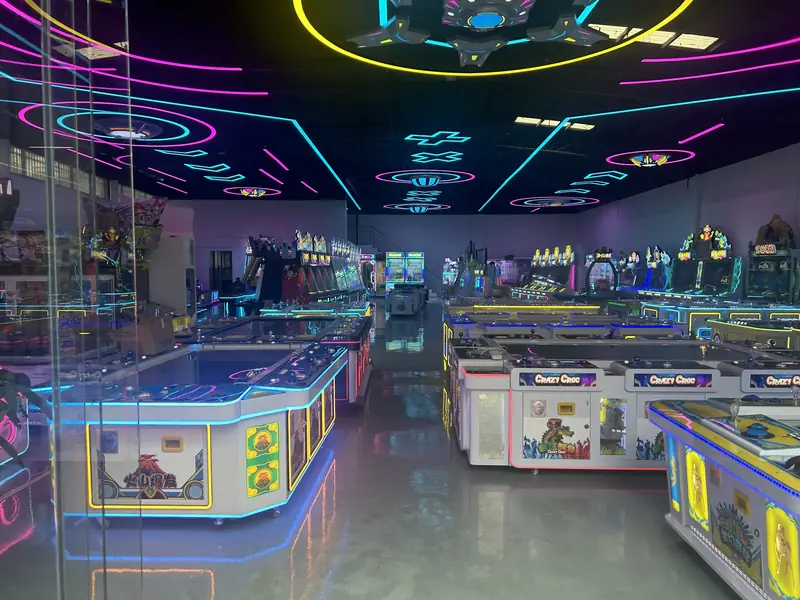
Add a contingency (indicatively ~10–15%) for the costs owners routinely underestimate: rent escalators, out-of-warranty repairs, first-batch consumables / prizes, and launch marketing. A published ~300㎡ FEC we documented landed delivered equipment-plus-system cost in a mid-six-figure local-currency range — use it only as a scale reference, not a quote.
Revenue-per-Seat: Your Local Input
Rather than assume a figure, build revenue from the ground up:
Monthly Gross Revenue = Revenue per seat per day × Play seats × Operating days per month
"Revenue per seat per day" must come from your own pilot, comparable venue or conservative estimate for your market — do not borrow someone else's. Seat count derives from your equipment-mix plan.
OPEX: The Monthly Drain
Plan recurring costs:
- Rent and occupancy (incl. escalators, utility sharing)
- Utilities and consumables / prizes
- Labor and payment-processing fees
- Maintenance and marketing
The Payback Formula
Payback (months) = Total CAPEX ÷ Average Monthly Net Operating Income
where Average Monthly Net Operating Income = Average Monthly Gross Revenue − Average Monthly OPEX.
Worked illustrative example (placeholders — replace with your data):
- CAPEX: your machine + fit-out + systems total
- Revenue / seat / day: your local rate
- Seats: from your mix plan
- OPEX: your monthly run-rate
→ Payback = CAPEX ÷ (gross − opex).
If the result looks too short to be believable, your inputs are optimistic; lengthen the assumption and re-run. Conservatism protects cash flow.
Revenue-per-Square-Metre: The KPI
Efficiency KPI: Revenue per m² = Period revenue ÷ Equipment-occupied area. Indicative reference bands vary by market (well-run floors often sit in a higher band; a low threshold around 500/㎡/month warrants caution, and tier-1 markets typically run above smaller ones). Use it to compare categories and retire chronic underperformers.
Optimization levers from floor practice: place high-throughput machines on main aisles, position redemption / ticket near the entrance (can lift throughput ~25% indicatively), and use memberships / packages to raise visit frequency and spend.
Risk Discipline
Common failure patterns include siting error, high machine downtime, compliance breaches, cash-flow shortfall and over-reliance on a single machine category. Diversify the mix and keep a working-capital buffer.
Compliance Note
This model is educational. Venue licensing, taxation and operation are the operator's responsibility. GOLDPRIME GAME provides compliant-ready equipment and certification documents on request; consult local professionals before committing capital.
FAQ
Q: Is the payback formula a guarantee? A: No. It is a planning tool. All inputs are operator-supplied and market-specific; results are indicative, not promised returns.
Q: What contingency should I budget? A: An indicative ~10–15% on CAPEX covers commonly underestimated items like retrofit, repairs, consumables and launch marketing.
Q: Why track revenue-per-square-metre? A: It is the core efficiency KPI for comparing categories and retiring underperformers; indicative healthy bands vary by market.
Q: Where do I get "revenue per seat per day"? A: From your own pilot, a comparable local venue, or a deliberately conservative estimate — never assume another market's figure.