
Key Takeaways
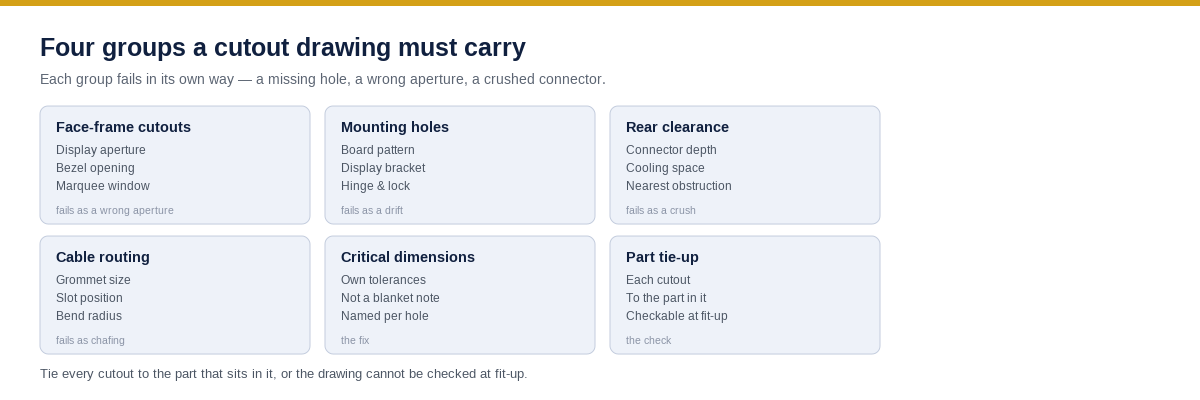
- A cutout drawing carries face-frame apertures, mounting holes, rear clearance and cable routing — four groups that fail in different ways.
- Mark the critical dimensions with their own tolerances; a blanket tolerance invites the factory to apply it to everything.
- Every cutout must be tied to the part that sits in it, or the drawing cannot be checked at fit-up.
Gaming Cabinet Cutout Drawing: What It Carries
A cutout drawing is not a pretty picture of the front; it is the dimensioned map of where everything sits. Four groups belong on it.
- Face-frame cutouts: the display aperture, bezel opening and any marquee or lighting window.
- Mounting holes: the patterns for the board, display bracket, hinge, lock and peripheral bezel.
- Rear clearance: the space behind the panel for connectors, cables and cooling.
- Cable routing: the grommets, slots and bend-radius paths the harness will follow.
Leave any group off and the drawing passes from engineering to the floor as a set of assumptions — and assumptions are where two parts stop fitting.
Mounting Holes and Tolerances
Holes carry patterns, and patterns carry parts. Mark the ones that must be exact.
- Board and display mounts: position, spacing and thread — these carry the parts that do not tolerate drift.
- Hinge and lock: the geometry the door swings and locks on.
- Peripheral bezels: acceptor, printer and reader cut-outs with their own apertures.
Give the critical holes their own tolerances and let a general note cover the rest. A single blanket tolerance for the whole panel says no hole matters — which is rarely true on a gaming cabinet.
Rear Clearance and Cable Routing
The back of the panel is where a drawing that fits in front fails in the field. Two things decide it.
| Item | What it prevents | What to dimension |
|---|---|---|
| Rear clearance | Connectors crushed against the shell | Depth behind the panel to the nearest obstruction |
| Cable routing | Harness chafing on sharp edges | Grommet size, slot position, bend radius |
Clearance is measured to the nearest obstruction, not to the panel back, because a connector that fits the panel and hits the shell is still a fail.
Copyable Cutout Drawing Checklist
Mark each line present, absent or not applicable, and tie every cutout to the part that sits in it.
- Display aperture with bezel reference
- Board and display mounting hole patterns with tolerances
- Hinge and lock geometry
- Peripheral cut-outs (acceptor, printer, reader) with apertures
- Rear clearance to the nearest obstruction
- Cable grommets, slots and bend radii
- Critical dimensions marked, not left to a blanket note
FAQ
What belongs on a gaming cabinet cutout drawing?
Four groups: face-frame cutouts (display, bezel, lighting), mounting holes (board, display, hinge, lock, peripherals), rear clearance behind the panel, and cable routing (grommets, slots, bend radii).
Why do mounting holes need their own tolerances?
Because they carry patterns for parts that do not tolerate drift. A blanket tolerance applied to every hole treats a board mount and a cosmetic hole the same, and the board mount is where a miss becomes a reject.
How is rear clearance measured?
To the nearest obstruction behind the panel, not to the panel back. A connector that fits the panel but hits the shell is still a fail, so the clearance dimension has to account for the obstruction.
What is the most common cutout drawing mistake?
Cutouts that are not tied to the part that sits in them. An aperture with no bezel reference cannot be checked at fit-up, so the factory assumes and the error surfaces at assembly.
Should every cutout get a tolerance?
No. Mark the critical dimensions — mounts, apertures, hinge and lock — with their own tolerances and let a general note cover the rest. Tolerating everything is the same as tolerating nothing.
Regulatory detail differs by jurisdiction and changes over time. Where a specification version or an effective date is named on this page, confirm it against the regulator's own publication before a build is released.
Get a Cutout Drawing That Fits First Time
Send the board, display and peripheral models you will fit. The reply returns a dimensioned cutout drawing with the critical dimensions marked.
Request a Quote →