
Key Takeaways
- Integration is judged on four tests: link, payment, control and record — not on whether the plugs fit.
- The central system protocol (SAS or GLI-13) is the line most cabinet suppliers cannot meet.
- The acceptance record must name exactly what ran; a record that lists nothing is a photograph.
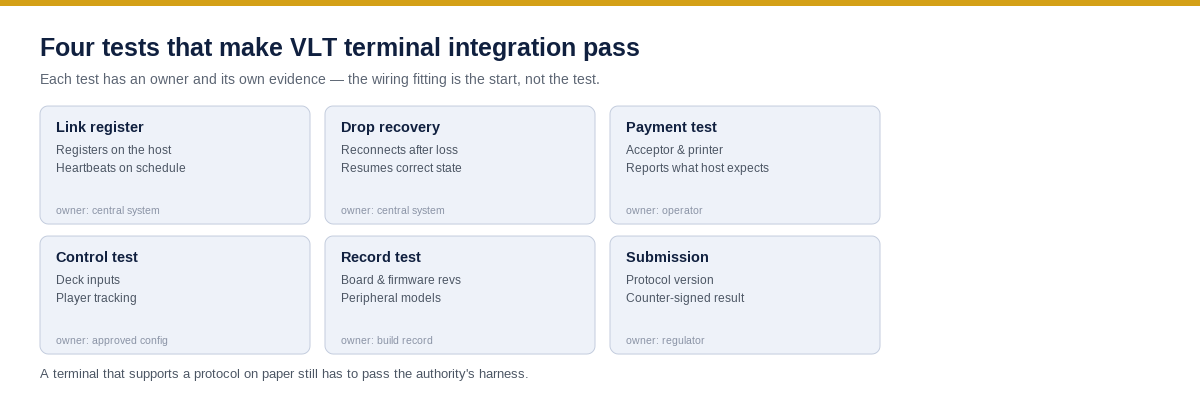
VLT Terminal Integration: The Four Tests
Integration is where a terminal stops being a cabinet. Four checks decide whether it is ready for a submission, and they are run in this order.
- Link test. The terminal registers, heartbeats and recovers from a dropped connection the way the programme expects.
- Payment test. Each device — acceptor, printer, reader — takes, records and reports what the central system expects to see.
- Control test. Deck inputs and the player-tracking interface behave under the approved configuration.
- Record test. The build record matches the machine: board, firmware, peripheral models and revisions.
A supplier who runs all four and keeps the evidence is describing a process; one who says the machine "works" is describing an intention.
Central System Protocol: SAS and GLI-13
VLT terminal integration turns on one question: which protocol the central system speaks. Two names come up most often.
| Protocol | Where it is used | What it governs |
|---|---|---|
| SAS | Slot accounting and cashless systems | Meters, handpays, cash and ticket events reported to the host |
| GLI-13 | Lottery and VLT programmes | Security, logging and the interface a terminal exposes to the central system |
The protocol is not a checkbox on the RFQ; it is the contract the terminal must honour. Ask the supplier which protocol version it has integrated against, and against whose test harness, because a terminal that "supports" a protocol on paper still has to pass the authority's harness.
What the Integration Record Must Contain
The acceptance record should name exactly what ran, not that something ran. Four fields make it usable.
- Build identity: board and firmware revisions, peripheral models and their revisions.
- Test results: each of the four tests with a pass or fail, not a summary.
- Harness version: the protocol version and the test harness it was run against.
- Disposition: what happened to any failed item — fixed and retested, or waived and by whom.
A record that lists two functions is evidence for two functions; a record that lists nothing is a photograph. Agree the format before the first test run, because a record produced after a reject is a negotiation document rather than an acceptance.
FAQ
What does VLT terminal integration actually test?
Four things: the link (register, heartbeat, drop recovery), the payment path (acceptor, printer, reader), the controls (deck and player tracking), and the record (board, firmware and peripheral revisions). The wiring fitting is the start, not the test.
What is the difference between SAS and GLI-13?
SAS governs slot accounting and cashless events reported to a host; GLI-13 governs the security, logging and interface a VLT exposes to the central system. Both are protocol contracts, not checkboxes, and the terminal has to pass the authority's test harness.
Who runs the integration test?
Usually the supplier runs it and the programme or an approved lab witnesses or re-runs it against the authority's harness. Ask who signs the record, because a self-issued record carries less weight than one countersigned by the authority.
Can a terminal pass on one protocol version and fail on another?
Yes. A protocol version change can alter meters, events or logging the terminal must expose, so a terminal approved against one version is not automatically approved against the next. Confirm the exact version in the submission.
What should I keep after integration passes?
The acceptance record naming the build identity, the four test results, the harness version and the disposition of any failed item. Keep it with the submission file, because it is the evidence a later audit or a peripheral change will be judged against.
Regulatory detail differs by jurisdiction and changes over time. Where a specification version or an effective date is named on this page, confirm it against the regulator's own publication before a build is released.
Integrate a Terminal Against Your Central System
Send the protocol and version, the central system you must connect to, and the peripheral models. The reply names the test harness and the evidence your submission will need.
Request a Quote →