
Key Takeaways
- No supplier can give you a single number for opening an arcade. The honest deliverable is a budget with an owner named against every line.
- Equipment splits into machines, game or board content, peripherals and systems. Only the first three are usually on one quotation.
- Landed cost and equipment cost are separate decisions. A cheap machine with an unplanned freight lane is not cheap.
- Every line needs six fields: quantity, unit price, currency, quote date, what is included, and whether it repeats monthly.
- Budget from a machine mix, not a machine count. Twenty identical cabinets and twenty mixed units cost differently per revenue seat.
- Leave a line blank rather than guess it. A blank line provokes a question; a guessed number becomes a decision.
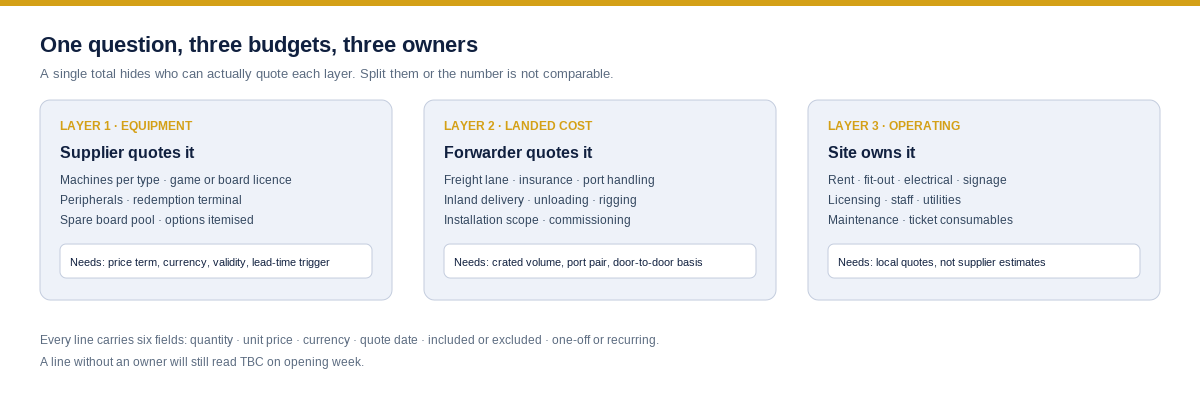
The table below is the working artifact. Copy the columns, add rows, and do not fill a price you have not been given in writing. Round numbers copied from a forum or a competitor's blog will survive into your business plan and then into your loan application, which is the expensive place to discover they were never sourced.
What Goes Into an Arcade Startup Budget?
Six fields per line, and five groups of lines. The fields matter as much as the lines: a total without a quote date and a currency is not a number you can compare against anything.
| Field | Why it is required |
|---|---|
| Quantity | Unit economics only appear once quantity is fixed; freight and spares scale differently from machines |
| Unit price | Leave blank until it is quoted in writing - a guessed price contaminates every downstream ratio |
| Currency | Equipment is usually quoted in one currency and freight in another; mixing them silently invents an exchange rate |
| Quote date and validity | An expired quote is a negotiation, not a price |
| Included or excluded | The single most common dispute: whether the price term covers freight, insurance, installation or duties |
| One-off or recurring | A licence fee and a cabinet look identical in a spreadsheet column and behave nothing alike in year two |
Group 1 - machines and content
Cabinet and complete machine per unit; game, board or software licence per unit; spare boards per site rather than per machine. Where the game is licensed rather than owned, split the licence into a one-off and a recurring line, because the two land in different budgets.
Group 2 - peripherals and systems
Bill acceptor, ticket printer, hopper or payout mechanism, redemption terminal, prize counter hardware, and the venue management or accounting layer. Note which of these the machine supplier includes and which the operator buys separately - many quotations stop at the cabinet edge.
Group 3 - landed cost
Freight, insurance, port and terminal handling, inland delivery, unloading and rigging, installation and commissioning. Ask the forwarder for a door-to-door figure and a separate ex-works figure so you can see what the lane actually adds.
Group 4 - site and compliance
Fit-out and flooring, electrical work, signage, licensing and permits, and any market-specific conformity work. These are locally priced and should never be estimated by a machine supplier.
Group 5 - operating
Rent, staff, utilities, maintenance contract, consumables such as ticket paper, and payment processing. These are monthly, and they decide whether the equipment investment services itself.
One boundary worth stating, because two different questions share the same words: this page budgets a venue. If the question is what one arcade machine costs to buy, or where to buy arcade machines for home use, that is a product decision rather than a startup budget, and it belongs with the machine range rather than here. Mixing the two produces a plan that looks complete and answers neither question.
How to Price Your First Machine Mix
Budget from a mix, not a count. A first order of twenty units built from four types costs differently from twenty of one type: tooling and artwork amortise differently, spare holdings multiply, and the revenue per seat varies by type. Price the mix in three passes.
- Fix the types and the counts. Four types is usually enough for a first floor: a core video or skill cabinet, a redemption or pusher unit, a large-format centrepiece, and one specialty. Write counts against each.
- Price per type, not per average. Asking for an "average machine price" produces a number that matches no line on the invoice. Ask for a per-type line with its option set.
- Add spares as a percentage of the fleet, not of the order. A spare board pool sized to the installed base survives the second order; one sized to the first order gets consumed and then re-bought at retail.
Two further disciplines keep the mix honest. First, keep the option set identical across types where possible, so the quotation is comparable line by line. Second, record why each type is in the mix - a redemption unit bought for footfall behaves differently from one bought for margin, and the reason determines which one you cut when the budget tightens.
The arithmetic convention should be stated on the quotation itself: base set plus options, per type, then multiplied by quantity, then totalled. The quote structure breakdown sets out that convention, and the cost structure page explains how price terms change the same equipment figure.
Freight, Installation and Payment Systems
Three lines are routinely under-budgeted because they sit between suppliers.
Freight and handling
Ask for the lane as a range with a stated basis: container type, loadable units, origin and destination ports, and whether unloading at site is included. Equipment quoted in a currency different from the freight quote needs both converted on the same date, or the budget carries an invisible exchange assumption. Crated volume, not machine count, sets the container cost - the container loading guide covers how units are packed and counted.
Installation and commissioning
Installation is not unpacking. It covers positioning, power connection to the local supply, network or LAN setup, peripheral calibration, test credits and a signed handover. If your quotation says "installation available", ask what is inside it and who signs the handover sheet.
Payment and redemption systems
Decide early whether the venue runs coin, note, ticket-out or card, because that choice moves cost between the machine, the peripheral and the back office. A cabinet prepared for one payment path and later converted to another pays twice. The MDB peripheral overview and the cashless readiness checks cover the interface questions to settle before ordering rather than after delivery.
For each of these three, the budget line should name the party who supplies the quote. A line that says "freight - TBC" with no owner will still say TBC on opening week.
Two Equipment Budget Scenarios
Two worked structures, both deliberately without prices, because prices belong to a quotation for a specific configuration, market and date. What the scenarios fix is the shape: how many lines, which lines scale with unit count, and which are fixed per site.
| Small venue (worked example) | Mid-size venue (worked example) | |
|---|---|---|
| Machine count | 12-16 units, 3 types | 36-48 units, 4-5 types |
| Content lines | Per-unit game or board | Per-unit game or board, plus one premium title |
| Peripherals | Acceptor and printer per unit; no separate redemption terminal | Acceptor and printer per unit, plus one or two redemption terminals and a prize counter |
| Systems | Basic accounting; LAN optional | Venue management system with reporting |
| Spares | A small board and harness pool held on site | A sized pool plus a documented swap procedure |
| Fixed per-site lines | Freight lane, installation, commissioning, signage | Same, plus staged delivery and phased commissioning |
| What scales with count | Machines, content, peripherals, ticket consumables | Same, at better unit economics |
| What does not scale | Freight base cost, installation, systems licence | Same, more slowly |
The useful output of the comparison is not the total. It is the ratio between fixed and variable lines: a small venue carries a higher fixed share per machine, which is why the per-seat cost of a small floor is usually worse and why cutting units from a small order saves less than expected. Run the same comparison on your own sheet before negotiating, and the discount conversation moves from percentage to structure.
Payback maths sits outside this checklist and belongs with the operating numbers: the FEC cost and profit model covers the payback calculation, and the machine cost structure covers price terms.
What to Send for a Quote
Download the worksheet: arcade-equipment-budget-worksheet.csv - 33 pre-named lines across the five groups above, with the six fields as columns and every price cell deliberately blank. Open it in a spreadsheet, delete the lines that do not apply, and fill a price only from a written quotation.
Then send one message with six fields, and the quotation comes back comparable instead of decorative.
- Site address or postcode. It sets the freight lane and the electrical standard. Without it, every price is ex-works and every landed cost is a guess.
- Floor area and shape. Square metres plus whether the space is rectangular, and any constraint such as a lift, a stair or a service corridor.
- Machine types and counts. Named by function rather than by model where you are still deciding: core cabinet, redemption, large-format, specialty.
- Payment path. Coin, note, ticket-out, card, or a mix, and whether a redemption terminal is needed.
- Target opening date. It determines whether the order can go on a single shipment and whether artwork has time to be approved before production.
- Currency and price term you want to compare on. Ask for one term, not three, or the comparison collapses.
Send the same six fields to every supplier. The value of a budget is comparability, and comparability comes from identical inputs - not from a longer email.
FAQ
Can a supplier tell me the total cost of opening an arcade?
No. A machine supplier can quote equipment and, at most, arrange freight. Rent, fit-out, licensing, staff and utilities are locally priced and owned by the site. A supplier who offers a single all-in figure is either estimating someone else's costs or hiding them inside the equipment price.
Should I budget per machine or per revenue seat?
Both, for different decisions. Per machine drives the purchase order and freight. Per revenue seat drives whether the floor is viable. A floor of expensive centrepieces can cost more per seat than a floor of core cabinets, so the mix decision belongs before the purchase order, not after.
What is usually missing from an arcade equipment quotation?
Installation scope, spare parts, ticket consumables, the management or accounting system, and the destination-market conformity work. All five sit outside a cabinet price and all five appear in the first year of operation. Ask which are included before comparing totals.
How many spare boards should a first order include?
Size the pool to the installed base rather than the order, and agree the swap procedure at the same time. A spare board without a documented swap and a return route becomes a shelf item, while the machine it was meant to rescue stays down.
Why keep price lines blank instead of estimating?
Because an estimate acquires authority it did not earn. Once a guessed number is in the sheet it drives the payback model, the loan application and the negotiation target. A blank line with a named owner produces a question and then a real number.