
Key Takeaways
- A social casino runs on virtual currency only — no real-money bets, no cash prizes; the sweepstakes variant adds a free-entry 'Sweeps' coin redeemable for non-cash prizes.
- Operators run it for acquisition and retention without real-money friction — lawfulness of the model is a market-by-market question; we supply the platform scoped per market, with local compliance sitting with the operator.
- GOLDPRIME GAME is a manufacturer + platform developer: cabinets, firmware, RNG and CMS from one accountable supplier, with GLI/BMM/CE per market / per order.


Introduction
Player acquisition has never been more expensive. Real-money expansion has never been more blocked. For a licensed operator in 2026, that squeeze is constant: demand for casino-style entertainment keeps rising, yet the license to sell it with real money is out of reach in most US states and a long list of markets. A social casino fills that gap the compliant way — virtual currency only, no real-money bets, no cash prizes — so licensed operators can run engagement, acquisition and retention without crossing into regulated gambling.
This page is a B2B hub, not a consumer app store. It is written for casino, arcade, family-entertainment-center (FEC), route and bar operators, plus the distributors who supply them — the people who evaluate a social casino platform and the supply partners behind it. We explain what the model is, how the sweepstakes mechanics work, why operators run it, what a compliant platform stack looks like, and where the legal lines sit in 2026. If you also want the consumer-side explainer on how players experience these games, our mobile game beginner guide covers the player view; this page stays on the operator and supply side.
The boundary is the whole point, so we state it up front: no real money in, no real money out. A social casino here means operator-run engagement using virtual currency or sweepstakes coins; prizes are merchandise or non-cash awards only. GOLDPRIME GAME supplies licensed, regulated-market operators and their distributors. We do not serve consumers, we do not promote real-money gambling, and we do not supply illegal gambling. Everything below assumes you operate (or distribute to) a licensed market, and the only baseline is compliance with that market's local law.
What a Social Casino Is (No Real-Money Model)
A no real money casino — often called a social casino — is a casino-style entertainment product: slots, table games, fish-shooters, instant-win and arcade titles, played with virtual currency instead of legal tender. Players never deposit real funds to play, and they never receive real funds as a result. The "money" inside the product is coins, credits or points with no cash value. That single fact is what keeps the experience in the amusement and promotional lane rather than the regulated-gambling lane.
If you have read the consumer-side coverage of "social casino games," you have seen the player-facing version: free-to-play slots and cards where the goal is entertainment, not income. We reference that term only to define the player model, then redirect to the B2B supply angle. This page does not compete for the consumer head term; it owns the operator-and-platform question — how a licensed business builds and runs one compliantly.
The cleanest definition for procurement teams is the no-money test. Ask two questions of any product: (1) Does a player put real money in to play? (2) Does a player take real money out as a prize? If the answer to both is "no," you are looking at a no real money casino model. The sweepstakes variant adds a prize path — but the prize is merchandise or non-cash awards, and a free entry method means no purchase is required to participate. We cover that mechanism in the next section.
Why this matters to an operator: a social casino is an engagement and acquisition engine, not a gambling product. It lets you build a player base, a brand and a data relationship in markets where a real-money license is out of reach. It also keeps you clear of the licensing, taxation and enforcement burden that comes with taking wagers. The trade-off is discipline — the no-money boundary must hold in every market you enter, which is exactly where the compliance section earns its length. A well-run social casino is boring in the best way: predictable, lawful and repeatable.
The Sweepstakes Mechanics
The sweepstakes model is the variant that unlocks prize redemption while staying outside real-money gambling. It uses a dual-currency structure, and the difference between the two coins is the legal key.
The Purchased Coin
The first currency is purchased. Call it Gold Coins, play credits or token packs — the name is yours, but the role is fixed: it is bought and used for play only. It carries no redeemable value. Revenue from this coin is straightforward: players buy entertainment, the way they buy any in-app content. There is no wager and no payout attached to it.
The Free Sweeps Coin
The second currency is given away free. This is the "Sweeps" coin. It is awarded through a no-purchase-necessary method — often a mail-in request, a daily login bonus or a free promotional grant. Because it is free to obtain, the promotion qualifies as a sweepstakes rather than a sale. Sweeps Coins can then be redeemed, but only for non-cash prizes: merchandise, goods or experiences defined in the official rules. No purchase is required to win, and the prize is never cash where the market disallows it.
That structure is the entire legal trick, and it is easy to break. The official rules must be published and clear. The free entry path (AMOE — alternate method of entry) must be live and usable. Redemption must stay inside the non-cash prize framework your counsel approves. A misstep — a hidden paywall on the free path, a cash-equivalent prize, a coin that quietly carries value — can collapse the distinction between a sweepstakes casino and an illegal lottery. This is why operators who treat the sweepstakes model as "just coins" are the ones who end up with a regulator's attention rather than a growing player base.
For operators who also run physical cabinets, the same dual-currency discipline maps onto the floor. The math models, RNG and content that power a sweepstakes casino on mobile are cousins of what runs on a certified cabinet — and the engineering discipline is similar. Our custom slot machine development track builds certifiable RNG and auditable math for both, so a single content roadmap can serve venue and mobile without rebuilding the logic twice.
Why Operators Run Social Casinos
Strip it back and the point is simple: a social casino platform lets a licensed operator grow a player base where real-money gambling isn't an option. Behind that sit three pressures every operator feels in 2026 — acquisition cost, market access and retention — and gamified engagement is what answers each one.
Acquisition Cost
Acquisition cost is the obvious pain. Paid user acquisition for real-money products is expensive and, in many markets, legally throttled. A social or sweepstakes product can be promoted through mainstream ad channels under the right policy, using entertainment-first creative rather than wagering claims. That lowers the cost of reaching a new player and widens the funnel before any compliance question arises, because the product itself takes no money in or out.
Market Access
Market access is the structural one. Most operators cannot simply "add real money" in a new state or country. A social casino sidesteps that wall: where the model is lawful, you can launch engagement and acquisition without a real-money license, then deepen the relationship as the legal picture allows. It is a way to be present in a market rather than absent from it — and presence is what compounds into a brand.
Retention
Retention is where gamified engagement pays for itself. Daily bonuses, streaks, tournaments, social leaderboards and shared progress turn a one-time player into a returning member. The pull is the same one that keeps players returning to a daily Wordle streak or a Candy Crush ladder — daily stakes, social proof, a reason to open the app tomorrow — except here it is wrapped in a compliant, no-real-money product. The result is a player relationship and a data asset you own, not rent.
Illustrative example, not a specific client — a bar-arcade operator in a no-real-money state used a social layer as a digital storefront for the venue. In-store players scanned a QR code, created a member profile and kept playing a branded slots-style game on their phones between visits. The social layer did not take bets — it took names. Over a quarter, the operator converted a meaningful share of walk-in traffic into a member list it owned, then used that list for events, happy-hour pushes and return visits. The arcade floor stayed the compliance-safe amusement product; the phone became the loyalty channel. The operator's takeaway was not "we made money on games" — it was "we now know our players."
For venue types built on time and groups rather than per-spin turnover, see our bar & arcade solutions and FEC solutions. A social layer is often the cheapest way to add a digital membership plane to a physical floor, and the one with the fewest compliance surprises.
Building a Compliant Social Casino (Platform Stack)
A compliant social casino is a system of social casino software and services, not a single app. The platform stack is the set of components that keep the no-money boundary intact, the sweepstakes rules enforceable and the operator in control of the data. For a licensed operator, the build decision is whether to assemble those components from several vendors or to source them from one accountable supplier.
Here is the component map:
| Layer | What it does | Compliance role |
|---|---|---|
| Game content | Slots, table, fish, instant-win, arcade titles in virtual currency | No real-money logic; auditable math |
| Dual-currency wallet | Separates purchased coin from free Sweeps coin | Enforces the sweepstakes split |
| PAM / CMS | Player account, config, reporting, content roadmap | One control plane for venue + mobile |
| Compliance engine | Geo-fence, KYC/AML, AMOE, rule publishing | Keeps the model lawful per market |
| Analytics | Retention, LTV, funnel, fraud signals | Informs safe scaling state-by-state |
| Payment integration | Licensed, transparent processors only | Avoids unlicensed aggregation risk |
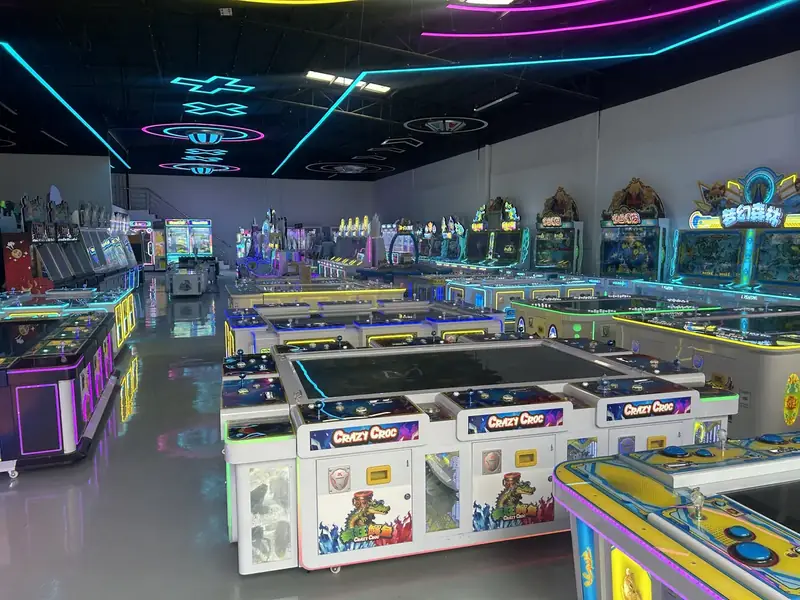
The differentiator most operators under-weight is unification. When the venue cabinet and the mobile app share one CMS, carry one player record and follow one content roadmap with identical compliance checks, you get a single source of truth. You are not reconciling a floor system with a phone system; you are running one business on one platform. That is also where a manufacturer plus platform developer has an edge over a pure software house: the cabinet, the firmware and the backend are designed as one product instead of bolted together after the fact, which keeps the player experience consistent from the boot screen to the bonus round.
Illustrative example, not a specific client — a land-based operator running fish-game cabinets wanted a mobile companion app without standing up a second vendor relationship. By unifying the cabinets and the mobile client under one CMS, the operator pushed the same tournaments, the same branded content and the same player IDs to both screens. Social interaction on the phone — leaderboards, shared challenges, friend invites — fed directly back to the venue: players came in to settle a challenge they had started at home. The cabinets were not "connected to an app"; the whole floor and the phone were one system, and the in-store traffic was the proof. The operator owned the platform and the data, so adding a new title or a new venue was a configuration change, not a re-platforming project.
GOLDPRIME GAME builds this stack as a manufacturer and platform developer. Our social casino software — firmware, CMS, player tracking and APIs — is the engine behind the platform; our slot machines and fish game machines are the venue side of the same architecture. One supplier, one accountable name when the regulator asks a question — and that accountability is the actual product, not the steel.
For the full component map — game engine, dual-currency wallet, PAM/CMS, compliance engine and certified RNG — see our social casino software page.
Compliance & Sweepstakes Law
This is the section operators skip and regret. Compliance for a social casino is not a disclaimer bolted to the footer — it is the precondition for every dollar you spend. The good news: the legal frameworks are established. The caution: they are fragmenting fast in 2026, and the fragmentation now reaches the supplier, not just the operator.
Start with the federal baseline. In the United States, promotional sweepstakes are governed by long-standing FTC guidance (see the FTC's sweepstakes guidance): no purchase may be required to win, official rules must be clear, and the free entry path must be real. Google's Ads Gambling & Games Policy treats compliant social casino content as free-to-play, which is why the ad-channel access above is possible in the first place. Meta's Advertising Standards set parallel rules for social promotion. These are the three authorities every operator should know before spending on acquisition, and they are the reason compliant creative can reach mainstream channels at all.
Then the state layer — and this is where 2026 gets sharp. Sweepstakes and social-casino law is state-by-state, and in 2026 the picture is moving and contradictory. New York's S5935A statute and pending bills in states such as Virginia and Minnesota are notable because they reach the service-provider layer: platform providers, game suppliers, payment processors, geolocation vendors and even media affiliates can fall within scope. In plain terms, a B2B supplier's own supply decision can be regulated, not just the operator's launch. Venable's May 2026 gaming alert lays out this service-provider exposure in detail; it is the authority we point operators to when they ask "does this affect my vendor?"
That reach changes the supplier conversation. A platform house that ships the same build everywhere is exporting someone else's risk. GOLDPRIME GAME takes the opposite stance, and we treat it as a feature, not a disclaimer: we scope supply per market and will not ship into a prohibited jurisdiction. GLI / BMM / CE certification — GLI-11 being the widely referenced RNG and device standard (see GLI) — is provided per market and per order, never implied as blanket global approval. When a state line moves, the build moves with it, and the operator is not left holding a product that suddenly has nowhere legal to land.
Illustrative example, not a specific client — an operator new to the model assumed "social means unregulated" and asked a developer for a single build to push across every US state. The developer agreed. Before launch, counsel flagged two problems: the free entry path was buried behind a purchase, and one target state had moved to restrict the exact dual-currency structure being proposed. The near-miss was expensive — rebuild, re-review, lost launch window. The operator then moved to a compliant dual-currency design with a live AMOE and a per-market supply plan. The lesson was not "lawyers are cautious"; it was that the no-regulation myth is the most expensive assumption in the category.
The compliance checklist, in one place:
- Free entry path (AMOE) live and usable — no purchase required to win.
- Official rules published, clear and per-market.
- Prizes non-cash (merchandise, goods, experiences) where the market requires it.
- Geo-fence and KYC/AML in the compliance engine, scoped per market.
- Licensed, transparent payment processing only.
- GLI / BMM / CE scoped per market and per order.
- Counsel sign-off documented before launch in each target market.
For the full mapping of certification and reporting to each jurisdiction, see our compliance overview. And the only baseline that survives every state line: confirm with local counsel and the regulator for your target market before you build or launch.
Social Casino vs Real-Money Casino
The distinction is simple to state and easy to blur, so here is the clean comparison.
| Dimension | Social / Sweepstakes Casino | Real-Money Online Casino |
|---|---|---|
| Money in | Virtual currency or free Sweeps coin | Real-money deposit |
| Money out | Non-cash prizes only (where allowed) | Cash winnings under license |
| License | No real-money gambling license required* | Full gambling license required |
| Reach | Market-specific; broader where lawful | Limited to licensed jurisdictions |
| Supplier risk | Growing state scrutiny (e.g., NY) | Heavy, license-bound |
*A sweepstakes and some states impose their own rules, and B2B suppliers face increasing state scrutiny — confirm per market.
The core line: a real-money casino takes a deposit, takes risk on an outcome, and pays cash winnings under a license. A social casino uses virtual currency with no cash settlement. They are separate legal worlds, and treating them as the same thing is the mistake that gets new operators burned — the one our mobile game beginner guide opens with. For a B2B operator, the practical difference is freedom of reach versus freedom of product: the social model trades cash prizes for the ability to operate in far more markets without a gambling license, provided the no-money boundary holds.
Who It's For
A social casino platform is not for everyone, and the red line is the first filter: we supply licensed, regulated-market operators and their distributors only. Inside that boundary, four operator profiles get the most from the model.
- Casino & gaming floors extending a brand into a no-real-money digital channel or a market where real money is blocked. See casino solutions.
- Bar & arcade operators adding a digital membership and loyalty layer to a physical floor. See bar & arcade solutions.
- Family entertainment centers built on time and groups, where gamified engagement drives repeat visits. See FEC solutions.
- Distributors and route operators who need a compliant, white-label social casino platform to offer operator-clients without taking on the build burden.
If you run slot machines or fish game machines on the floor, a social layer is the natural digital extension — same brand, same CMS, same player record. The operators who benefit most are the ones who already own a venue and want to extend it, not the ones chasing a cash-prize product they cannot legally run.
Conclusion
A social casino platform is the compliant answer to a real operator problem: how to acquire and retain players where real-money expansion is blocked. The model runs on virtual currency, no cash prizes, and — in its sweepstakes form — a free entry path that keeps it lawful. The boundaries are clear: no real-money gambling on the platform, GLI/BMM/CE scoped per market and per order, and market-by-market lawfulness confirmed by the operator with their counsel.
GOLDPRIME GAME builds the whole stack — cabinets, firmware, RNG, CMS and our social casino software — as one accountable manufacturer and developer. If you are scoping a compliant social or sweepstakes product, start with our game platform development track, and review the compliance overview before you commit budget. The operators who win here are the ones who treat compliance as the first line of the plan, not the footnote — and who use gamified engagement to turn a compliant product into a durable player relationship.
Ready to scope your build? Request a quote and we'll come back with a tailored plan in ~72 hours — built around how you operate, where you're licensed, and what your players expect.
Frequently Asked Questions
What is a social casino?
A no-real-money casino — also called a social casino — is casino-style entertainment played with virtual currency only: no real-money bets and no cash prizes. Players use coins or credits with no cash value; the sweepstakes variant adds a free-entry coin redeemable for non-cash prizes. It is engagement, not gambling.
Is a social casino real money?
No. A social casino involves no real funds wagered and no real funds paid out. The sweepstakes variant adds a free-entry "Sweeps" coin that can be redeemed for non-cash prizes only. No purchase is required to win, and cash prizes are not offered where law disallows them.
How does the sweepstakes model work?
The sweepstakes model uses two currencies: purchased coins for play only, and free "Sweeps" coins granted via a no-purchase-necessary method. Sweeps coins redeem for non-cash prizes under published official rules. Because entry is free, the promotion stays outside real-money gambling.
Is a social casino legal?
Legality depends on the model and the market. A compliant sweepstakes needs a free entry path and official rules, and state law is fragmenting in 2026 (e.g., NY S5935A). Confirm with local counsel. GOLDPRIME supplies the platform and its documentation, scoped per market; lawful operation in the destination market is the operator's call.
What are social casino platform requirements for operators?
Operators need game content, a dual-currency wallet, a PAM/CMS, a compliance engine (geo-fence, KYC/AML, AMOE), analytics and licensed payment integration — ideally unified under one platform. A manufacturer-plus-developer supplier reduces the vendor risk across that stack.
What is the difference between a social casino and an online casino?
An online casino takes deposits and pays cash winnings under a gambling license. A social or sweepstakes casino uses virtual currency with no cash settlement and offers non-cash prizes only. The social model reaches more markets without a real-money license, where lawful.
How do you start a social casino?
Plan the model, confirm the legal lane per market with counsel, choose a compliant platform or development partner, soft-launch to a narrow audience, monitor payment and redemption flows, then scale state-by-state. Each new market is a fresh legal question, not a copy-paste launch.
Does a social casino need a gambling license?
Generally no real-money gambling license is needed, since there is no wager or prize of value. But sweepstakes law and some states impose rules, and B2B suppliers face rising state scrutiny (e.g., NY). Confirm requirements with counsel per market before launch.
What games can a social casino include?
A social casino can include slots, table games, fish-shooters, instant-win, lottery-style and skill or arcade titles — all played in virtual currency. Content is chosen for engagement and compliance, not for cash payout, and is tuned to the operator's market and player base.
Can a social casino run on land-based cabinets too?
Yes. A manufacturer-plus-platform partner can unify venue terminals and mobile under one CMS, so the same player record, content and compliance checks run on both screens. This omni-channel setup lets social interaction on the phone feed traffic back to the venue.