
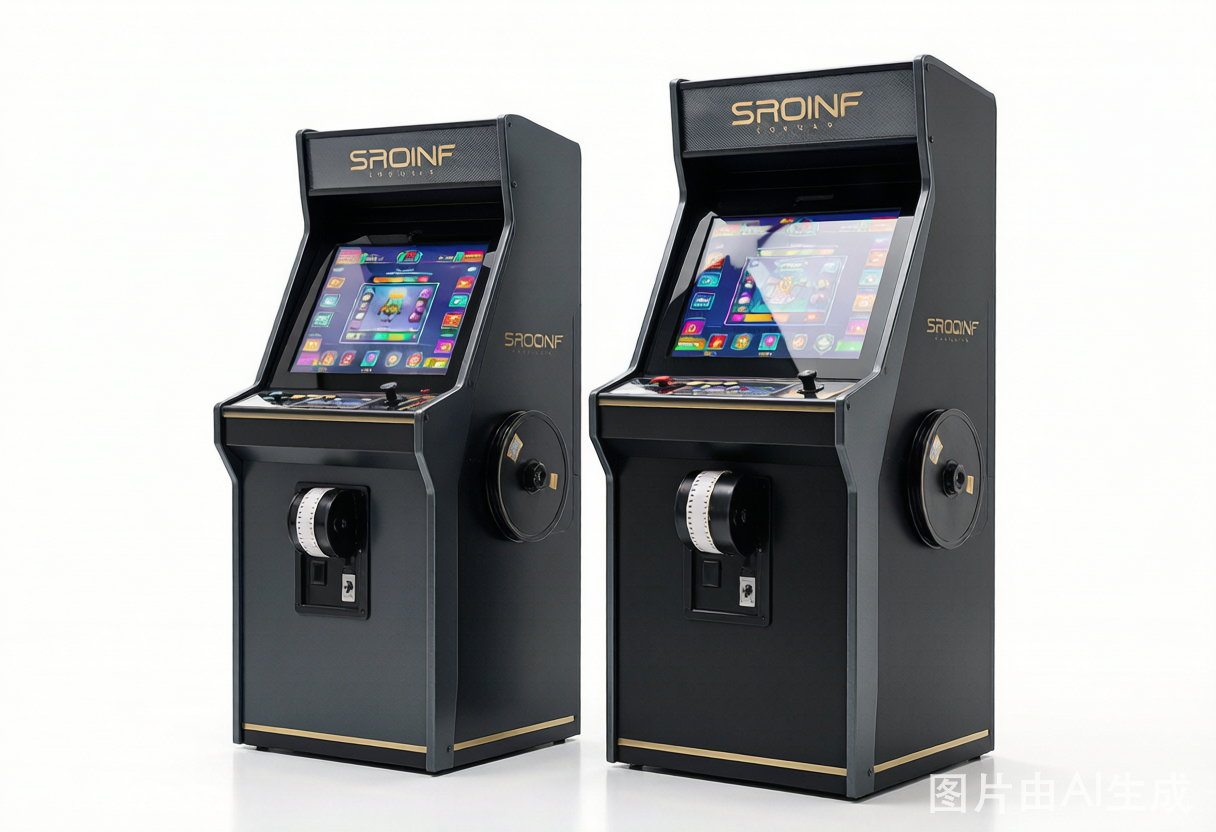
A skill game cabinet is a commercial-grade amusement or gaming enclosure built to hold a large-format display, player controls, a payment system (bill acceptor, coin mech, or cashless reader), and the game board that drives gameplay. The Solaris Cabinet Series takes that definition and engineers it for one audience above all: the operator who needs control, compliance, and uptime. This guide walks through exactly what Solaris is, the numbers behind its build, and where it fits inside bars, convenience stores, family entertainment centers, and routed locations.
You probably didn't wake up this morning thinking about cabinet steel gauge. But if you run even one machine on a revenue floor, the cabinet around your game board decides three things you care about: how much you earn, how often it breaks, and whether a regulator can shut you down. We'll show you why the Solaris was built the way it was — and how to pick the right configuration for your venue.
Key Takeaways - The Solaris supports skill, nudge, and zero-chance modes, switchable per location, so one cabinet serves amusement and compliant-gaming floors alike. - Its operator-level mode lock disables prohibited payout modes at the firmware layer — a concrete compliance safeguard for Pennsylvania, Texas, and Florida operators (see our legal breakdown). - Two screen sizes (43" and 55") and a powder-coated steel frame cover bar, c-store, FEC, and route deployments from a single parts platform. - Solaris pairs natively with the F600 redemption kiosk (bill acceptor + ticket-out) to build a clean cashless or ticket-redemption loop. - Modular internals mean a game-board swap takes minutes, not a service call — protecting uptime and resale value.
Before we get into specs, let's be honest about what most cabinets on the market are: a wooden or thin-steel box with a screen bolted on. They look fine in a showroom. Then they sit in a humid bar for nine months, the MDF swells, the coin mech rattles loose, and you're on the phone with a technician at 11 p.m. on a Saturday.
Solaris was designed by engineers who got tired of those calls. It's a commercial fish game cabinet and broader skill-game platform built around three ideas: a reinforced steel skeleton, a payment system that an operator — not a player — controls, and a firmware-level configuration lock.
The series ships in two screen formats (43" and 55") and supports up to 6 simultaneous player stations on the 55" model. Every unit is pre-wired for a bill acceptor, thermal printer, and coin interface, so you choose the payout logic that matches your location's legal footing. An arcade cabinet with bill acceptor is the default build — the panel is pre-cut, so you don't cut the cabinet to install the validator.
Explore the full Solaris build and current configuration options → (product page in progress)
Marcus runs three bars across central Pennsylvania. In early 2026, before the state's June Supreme Court ruling, he was operating generic skill cabinets he'd bought on price. When the court declared unlicensed skill devices subject to the Gaming Act and Crimes Code — with a 120-day window to October 13, 2026 — Marcus faced a real problem: his machines had no clean way to prove which payout mode was active.
He'd already swapped two locations to Solaris during a floor refresh. Because Solaris lets an operator lock the cabinet into a compliant mode at the firmware level, Marcus could document that those two bars were running ticket-redemption (amusement) configuration only. The third bar, still on the old generic units, took three weeks and a consultant to reconfigure — and he ultimately pulled it. "The lock isn't just a feature," he told us. "It's the difference between a signed compliance letter and a seized machine."
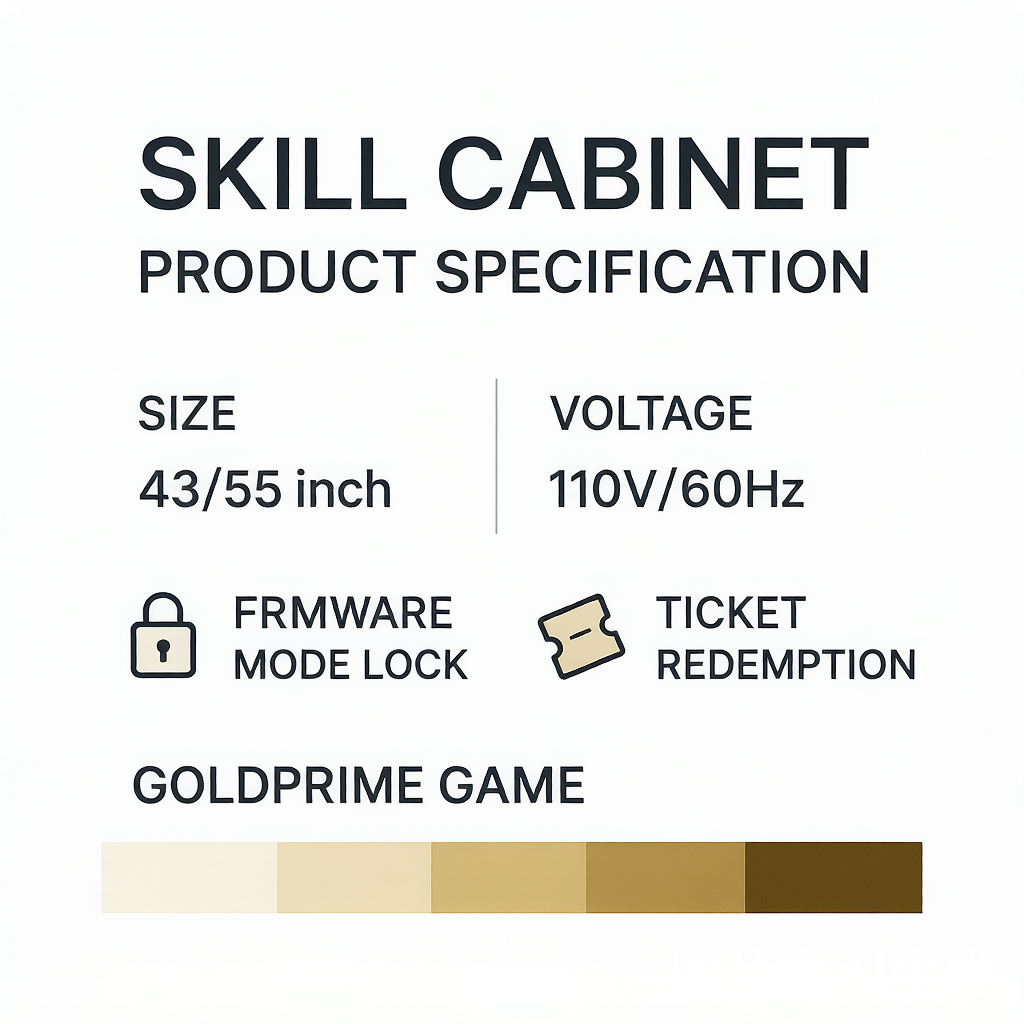
Here's the spec sheet operators actually ask about. Numbers are the production-standard build for the 2026 Solaris series.
| Spec | Solaris 43" | Solaris 55" (6P) |
|---|---|---|
| Display | 43" full-HD LCD | 55" full-HD LCD |
| Player stations | 2–4 (configurable) | Up to 6 |
| Cabinet material | Powder-coated steel frame | Powder-coated steel frame |
| Control deck | Acrylic panel, LED-lit buttons | Acrylic panel, LED-lit buttons |
| Payment | Bill acceptor + coin mech + printer-ready | Bill acceptor + coin mech + printer-ready |
| Game modes | Skill / Nudge / Zero-chance | Skill / Nudge / Zero-chance |
| Mode control | Operator-level firmware lock | Operator-level firmware lock |
| Audio | 2.1 stereo with subwoofer | 2.1 stereo with subwoofer |
| Voltage | 110V–220V auto-range | 110V–220V auto-range |
| Companion | Pairs with F600 redemption kiosk | Pairs with F600 redemption kiosk |
A few notes on what those rows mean in the field. The auto-range power supply matters more than it sounds: route operators moving machines between states don't rewire. The printer-ready design means you can run ticket-out redemption without cutting the cabinet — the access panel is pre-cut. And the steel frame, at commercial gauge, is the reason the unit survives a venue that a wood cabinet wouldn't.
Explore the Solaris 43" and 55" configurations in detail →
A 55" six-player cabinet is a centerpiece. It belongs in a family entertainment center or a large bar with floor space and foot traffic. A 43" two-to-four-player unit is the workhorse for convenience stores, smaller bars, and route stops where square footage is precious. Offering both from one parts platform means your spare boards, joysticks, and locks are interchangeable — a real cost saver at fleet scale.
This is the section that matters most if you operate in a regulated U.S. market. Here's what "operator-level mode lock" actually means — and why we built it that way.
A skill game cabinet can run in different payout modes. In a skill mode, outcome is genuinely player-skill weighted. In a nudge mode, the game offers a small player-influenced adjustment. In a zero-chance mode, the result is purely mechanical-random with no skill element — think of a pure coin-flip, not a player's reflexes. In several states, that configuration falls outside what an unlicensed operator may run.
The Solaris operator-level mode lock does one job: once you set the permitted mode for a location, the firmware seals it. A player can't toggle it from the control deck. A curious employee can't "experiment" in the settings menu. The mode is locked at the layer a regulator or inspector would check.
We covered the legal backdrop in detail in our 2026 Pennsylvania skill-game compliance window breakdown. The short version for 2026:
The Solaris lock lets you disable prohibited payout mode by firmware — meaning you can ship a machine to a strict-jurisdiction location and know, on paper and in practice, that the prohibited mode simply cannot be activated there. That's the kind of documentation Marcus used in the story above, and it draws on the same state legal backdrop for mode lock we publish for operators.
Ready to see how operator-level mode lock works on your floor? Talk to our team about a compliant configuration →
A lot of generic cabinets have a settings password. That's not the same thing. A password lives in the same menu a tech opens during service; it can be reset, bypassed, or forgotten. The Solaris lock is written into the firmware configuration the board boots from. To change it, you need the operator credential and a deliberate reflash step — not something that happens by accident at 2 a.m. For an operator building a compliance file, that distinction is the whole ballgame.
No two venues earn the same way. Here's how we'd configure the Solaris skill cabinet for the four most common locations we hear about.
Recommended build: 43" or 55" in skill or nudge mode, bill acceptor enabled, operator lock set to your state's permitted mode.
Bars live and die on atmosphere and dwell time. A 55" six-player Solaris in the back corner becomes a social anchor — groups gather, rounds get ordered. Keep the volume controlled (the 2.1 system has a separate subwoofer gain) and the attract-mode lighting tasteful. For tighter bar footprints, the 43" four-player unit tucks against a wall without dominating the room.
Recommended build: 43" two-to-four-player, bill acceptor primary, ticket-out redemption if your state treats ticket payout as amusement.
C-stores need a machine that earns without a staff member babysitting it. The steel frame shrugs off the humidity and temperature swings of a retail back room. The pre-cut bill acceptor panel means install is plug-and-play. One operator we work with runs four c-store stops on a weekly route and rotates game boards between them using the modular swap — more on that below.
Recommended build: 55" six-player, ticket-redemption (coin-in / ticket-out) mode, paired with the F600 kiosk.
FECs are the cleanest compliance story: ticket redemption is classic amusement, not gaming. Here the Solaris shines as a group attraction, and the F600 handles prize payout so your counter staff isn't hand-counting tickets. This is also where the larger screen pays for itself — families photograph it, post it, and come back.
See the F600 redemption kiosk product page for the full pairing setup →
Recommended build: Mixed 43"/55" fleet, modular boards, operator lock pre-set per stop's jurisdiction.
Route operators are the reason Solaris has interchangeable internals. You might run a 55" in a compliant-gaming bar on Monday and a 43" in a c-store on Tuesday — same spare parts, same service routine. Pre-setting the mode lock per stop means your driver never has to make a compliance decision on-site. That removes risk and speeds every service call.
If you're planning a route from scratch, our step-by-step guide to starting a fish-table business covers site selection, licensing, and fleet math in detail.
A redemption kiosk cabinet completes the loop a modern venue needs: players earn, then they cash out without a staff bottleneck. The Solaris is the play surface; the F600 is the payout surface.
The F600 is a cash redemption machine built around a high-capacity bill acceptor and a clean ticket-to-cash (or ticket-to-prize) workflow. Paired with a Solaris running ticket-out mode, you get a closed system:
This split — game on one cabinet, redemption on another — is the standard FEC architecture and it's exactly why Solaris ships printer-ready. You're not hacking two functions into one box; you're running two purpose-built units that talk to each other through the ticket system.
Dana runs a single convenience store in a suburban Texas strip mall. She started with a generic cabinet that paid cash directly — and immediately ran into questions about payout documentation. After switching the play cabinet to Solaris ticket-out mode and adding an F600 at the counter, her redemption volume (tracked as tickets, not cash) roughly doubled over two quarters. Why? Parents felt comfortable letting kids play a ticket game; the counter kiosk turned tickets into a plush toy or a drink voucher. "The cabinet didn't change the game," Dana said. "The payout path changed who would play it."
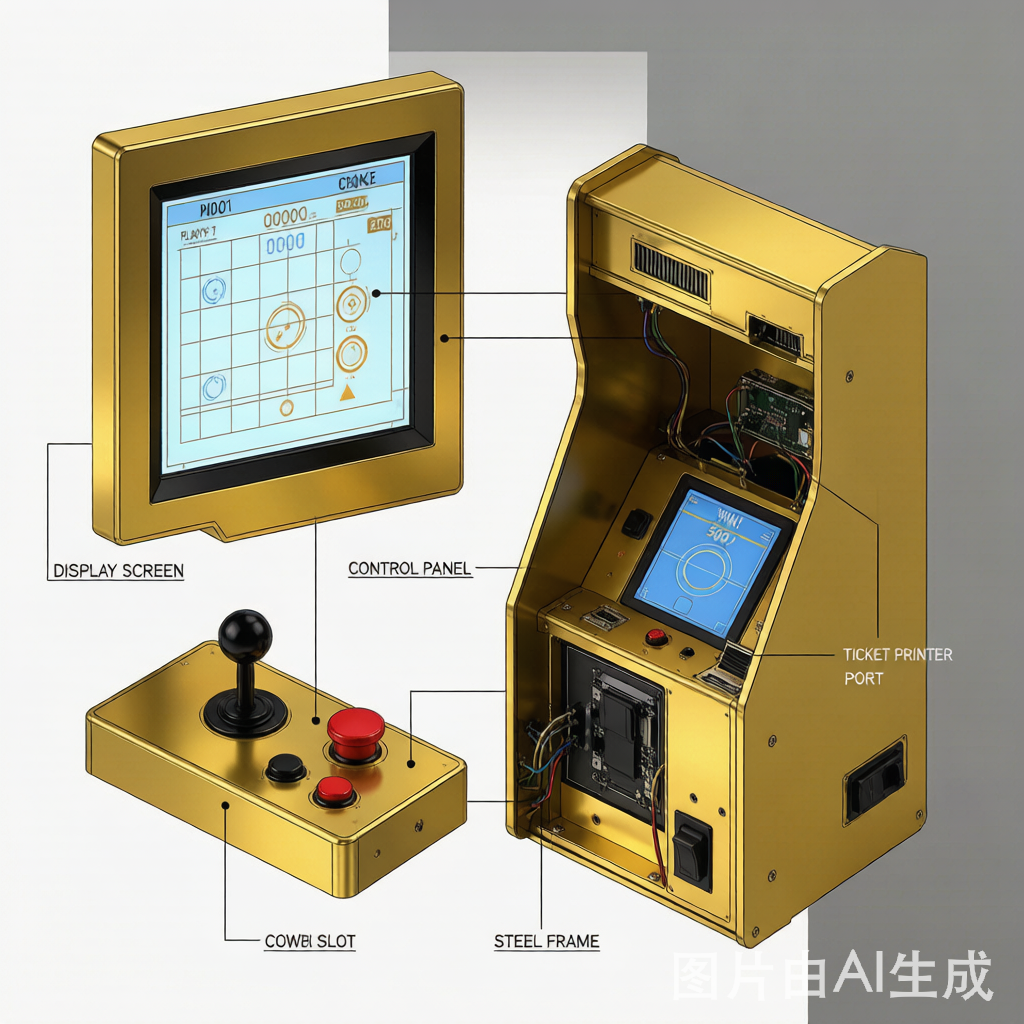
Let's talk about the boring parts that decide your ROI: the frame and the internals.
Wood and thin-gauge steel cabinets fail the same way: moisture, then warp, then the screen mount drifts and the coin mech loosens. In a commercial environment — bars with spills, c-stores with HVAC swings — that's not an "if," it's a "when." The Solaris powder-coated steel frame resists corrosion and holds alignment for years. Independent build guides note that a reinforced steel chassis resists the warping that sidelines wood-frame units in high-traffic venues (source: Guangdong fish game machine materials guide; industry context also aligns with commercial-grade equipment standards from AGEM). We spec'd to that standard on purpose.
Every internal component in the Solaris uses a board you unplug and plug back in — each one clearly labeled. Change a game title? Unplug the old board, plug in the new. No soldering, no harness rewiring, no technician flight. For a route operator, that's the difference between a 20-minute stop and a lost day.
It also protects resale. A cabinet you can re-game is a cabinet a buyer wants. A cabinet welded shut around a dead title is scrap. Modular design is why our fish game machine price & cost breakdown treats the cabinet as a long-term asset, not a sunk cost.
We're not going to pretend every operator needs a Solaris. If you run a single machine in a clearly unregulated novelty setting and never move it, a budget box might do. But here's the side-by-side most buyers actually care about.
| Factor | Generic cabinet | Solaris Cabinet Series |
|---|---|---|
| Frame | Wood / thin steel | Powder-coated commercial steel |
| Mode control | Settings password (bypassable) | Firmware-level operator lock |
| Compliance documentation | Manual / unclear | Locked mode is inspectable |
| Screen options | Often one size | 43" and 55" from one platform |
| Payment prep | May require cutting | Pre-cut for bill acceptor + printer |
| Modular swap | Often welded | Labeled quick-disconnect boards |
| F600 pairing | Adapter needed | Native ticket-out workflow |
The gap widens the moment compliance or uptime enters the conversation. A generic cabinet is cheaper on the invoice. Solaris is cheaper across three years of operation once you price in service calls, seized-machine risk, and resale.
For a balanced view, our how-to-choose guide for commercial fish game cabinets walks the full decision tree — including when a budget unit is genuinely fine.
What screen size should I choose for a small bar? For bars under about 1,200 sq ft, the 43" four-player Solaris fits a wall without eating floor space. Go 55" only if you have a designated game area and decent foot traffic.
Can the operator-level mode lock be changed after install? Yes, but only through the operator credential plus a deliberate firmware reflash — not from the player deck or a quick settings menu. That's the point: it can't be flipped by accident or by a player.
Is Solaris legal in Pennsylvania after the 2026 ruling? The June 15, 2026 Supreme Court ruling subjects unlicensed skill devices to the Gaming Act with a grace period to October 13, 2026. Solaris lets you lock into a non-prohibited mode and document it, but you must confirm your specific operation against current state guidance. See our PA/TX/FL legal breakdown and consult counsel.
Does Solaris work with my existing game board? Solaris supports standard fish-game and video-redemption boards through its modular harness. Compatibility depends on your board's interface; our team confirms fit during configuration. Contact us with your board model →
How long does a game-board swap take? With the labeled quick-disconnect design, a trained operator swaps a board in roughly 15–20 minutes, no soldering required.
What's the lead time and warranty? Production lead times vary by configuration; the steel-frame build and 12-month structural warranty apply across the series. Exact terms are confirmed at order.
The Solaris Cabinet Series isn't the cheapest box on the market, and we've never pretended it is. What it is: a skill game cabinet engineered so the person who owns it — not the person playing it — stays in control. The steel frame earns uptime. The operator-level mode lock earns peace of mind in a year when regulators are paying attention. And the modular, F600-ready design earns you a machine you can re-game, resell, and route without a technician on speed dial.
If you're configuring a floor for 2026, the smartest first move is a conversation, not a purchase. Tell us your state, your venue type, and your payout comfort level — we'll spec the exact Solaris build (and the F600 pairing) that fits.
Ready to spec your Solaris Cabinet with our team? Start your configuration conversation →
Meta Title: Solaris Skill Cabinet: Specs & Use Cases 2026 Meta Description: Solaris commercial fish game cabinet specs: operator-level mode lock, 43"/55" screens, F600 redemption pairing. Configure your build today. Primary Keyword: skill game cabinet Secondary Keywords: Solaris skill cabinet, commercial fish game cabinet, operator-level mode lock, redemption kiosk cabinet, arcade cabinet with bill acceptor URL Slug: /blog/en/solaris-cabinet-series/ Word Count: ~2,900
<head> injection){
"@context": "https://schema.org",
"@type": "Article",
"headline": "Solaris Skill Cabinet: Specs & Use Cases (2026)",
"description": "Solaris Skill Cabinet specs and use cases (2026): steel-gauge build, firmware-level mode lock, native ticket redemption, 43\"/55\" sizes for bars, C-stores, FECs, and routed locations.",
"inLanguage": "en",
"datePublished": "2026-07-15",
"author": {
"@type": "Organization",
"name": "GOLDPRIME GAME"
},
"publisher": {
"@type": "Organization",
"name": "GOLDPRIME GAME"
},
"mainEntityOfPage": {
"@type": "WebPage",
"@id": "https://www.chinaslotmachine.com/blog/en/solaris-cabinet-series/"
}
}
{
  "@context": "https://schema.org",
  "@type": "Product",
  "name": "Solaris Skill Cabinet",
  "description": "Commercial-grade skill game cabinet with steel frame, firmware-level payout-mode lock, and native ticket-redemption. 43\" and 55\" sizes share one spare-parts kit.",
  "brand": {
    "@type": "Brand",
    "name": "GOLDPRIME GAME"
  },
  "category": "Commercial amusement / skill game cabinet",
  "additionalProperty": [
    {
      "@type": "PropertyValue",
      "name": "Display sizes",
      "value": "43 inch / 55 inch"
    },
    {
      "@type": "PropertyValue",
      "name": "Payout model",
      "value": "Ticket-redemption (native), firmware-level mode lock"
    },
    {
      "@type": "PropertyValue",
      "name": "Cabinet",
      "value": "Steel frame, commercial grade"
    },
    {
      "@type": "PropertyValue",
      "name": "Voltage",
      "value": "110V/60Hz (North America)"
    }
  ],
  "offers": {
    "@type": "Offer",
    "priceCurrency": "USD",
    "availability": "https://schema.org/InStock",
    "url": "https://www.chinaslotmachine.com/blog/en/solaris-cabinet-series/"
  }
}