
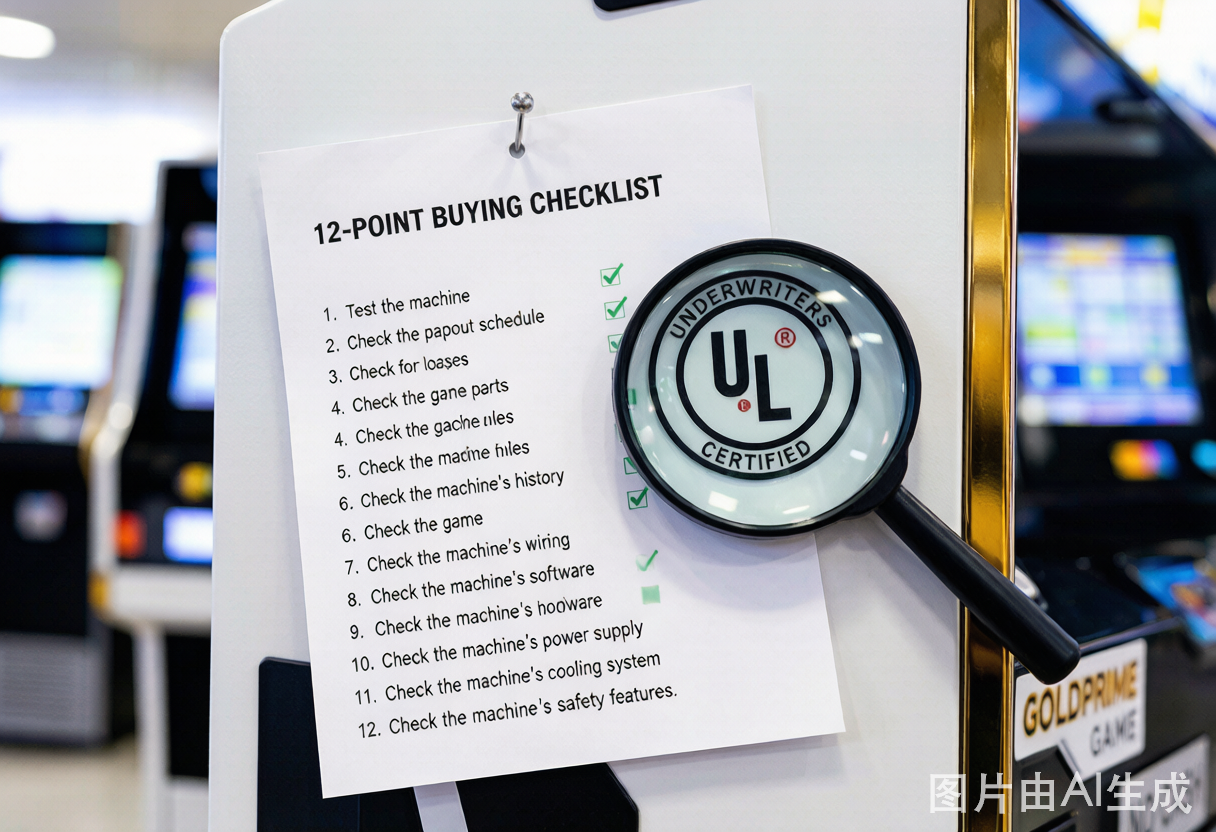
A fish game machine buying checklist is the single most important document you can create before spending $8,000–$25,000 on commercial arcade cabinets. Without one, you risk receiving machines with wrong voltage, missing safety certifications, unlicensed software, or no after-sales support. Those problems turn profitable locations into expensive paperweights.
This 12-point checklist covers hardware, software compliance, supplier vetting, and contract terms. It's built specifically for North American operators sourcing fish table cabinets from overseas manufacturers.
Marcus thought he'd found a great deal. Six fish game cabinets from an Alibaba supplier, $2,300 each, shipping included. The listing said "arcade game machine, high quality, factory direct." What it didn't say was that all six ran on 220V/50Hz—the Chinese domestic standard. When Marcus plugged the first cabinet into his 110V outlet in Houston, the power supply sparked, smoked, and died before the screen even flickered. All six machines shared the same fate. $14,000 in inventory became six oversized doorstops, and the supplier's only response was a refund offer of $200 "for the inconvenience."
This is why you need a fish game machine buying checklist. Not a mental list. Not "I'll ask the seller." A written, item-by-item verification document that you work through before you wire a single dollar. This article gives you that checklist—12 specific points covering hardware specs, software compliance, supplier credibility, and contract terms. Every point includes what to check, what "pass" looks like, and the red flags that should make you walk away.
One boundary before we start: this checklist focuses on commercial amusement and compliant ticket-redemption skill game procurement. We do not cover, recommend, or discuss gambling-inducement configurations. If you're operating in Pennsylvania, Texas, or Florida, pay special attention to the compliance section—state laws changed significantly in 2026.
If You Read Nothing Else - Verify 110V/60Hz power and UL/ETL certification before ordering—220V-only cabinets are unusable in North America without costly modification. - Firmware-level payment mode lock and native ticket-redemption support are non-negotiable for compliant skill game operation. - A supplier who refuses video factory audits or sends only renderings instead of real product photos is a supplier you should avoid. - Warranty must be written, specific (≥12 months, PCB/screen/compressor covered), and backed by documented spare-parts availability. - FOB shipping without customs assistance can add $3,000–$5,000 in surprise costs and delay your opening by 2–4 weeks. 中文读者:我们另有 中文版商用设备选购指南(2026)→,面向北美华人开店者的整包设备采购逻辑。
The global arcade game machines market was valued at $10.99 billion in 2025 and is projected to reach $31.03 billion by 2033, growing at a CAGR of 14.8% (Grand View Research). That growth means more suppliers and more options. It also means more variance in quality and compliance—and that's what bites you.
The barrier to listing products on B2B platforms is effectively zero. Anyone can create a listing, grab stock photos, and quote you a price. When you're buying a single fish game cabinet for a home game room, a mistake costs you a few hundred dollars and some frustration. When you're buying six, twelve, or twenty cabinets for a commercial arcade or family entertainment center, a mistake costs you five figures and potentially your business license. The difference between a profitable fish table operation and a disaster often comes down to whether you verified the right things before the money left your account.
A fish game machine buying checklist forces you to confront specifics—actual voltage numbers, actual warranty terms, actual shipping incoterms—instead of vague reassurances from a sales rep. It also creates a paper trail: if something goes wrong, you have documented evidence of what was promised. And it filters out bad suppliers fast. A supplier who can't answer twelve specific questions is a supplier who can't support you after the sale.
Here's the thing: the global arcade machines market sits at $4.01 billion in 2025 with expected growth to $6.42 billion by 2034 (Dataintelo). Suppliers are fighting for a share of that growth. The ones who welcome your checklist have invested in compliance. The ones who dodge it are cutting corners—and hoping you won't notice.
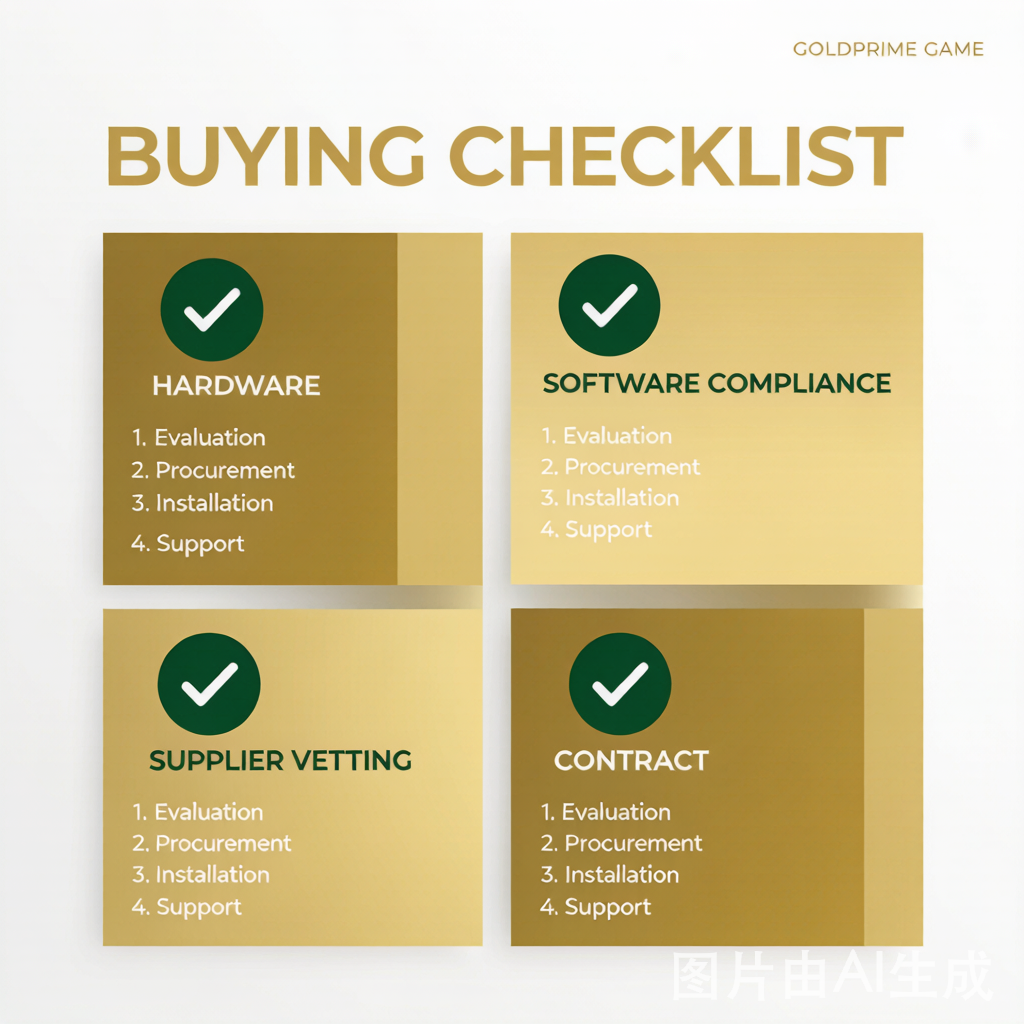
A fish game machine buying checklist is a 12-point verification document that covers hardware specifications, software compliance, supplier credibility, and contract terms. Use it before ordering commercial arcade cabinets to prevent costly mistakes involving voltage incompatibility, missing certifications, unlicensed software, or inadequate after-sales support.
| # | Category | What to Verify | Pass Standard |
|---|---|---|---|
| 1 | Hardware | Display size & resolution | ≥1080p, named panel brand |
| 2 | Hardware | Voltage & certification | 110V/60Hz, UL 22 listed |
| 3 | Hardware | Cabinet material | Powder-coated steel ≥1.2mm |
| 4 | Software | Payment mode lock | Firmware-level lock, admin-only |
| 5 | Software | Ticket-redemption support | Native thermal printer, pre-wired |
| 6 | Software | Anti-cheat firmware | Versioned, documented update history |
| 7 | Supplier | Factory & export credentials | Verifiable registration, video tour |
| 8 | Supplier | Warranty terms | ≥12 months, written, specific coverage |
| 9 | Supplier | Spare parts catalog | Documented list, 7–15 day shipping |
| 10 | Contract | Incoterms & shipping | DDP preferred, customs support |
| 11 | Contract | Technical SLA | ≤24h email, ≤48h video, English contact |
| 12 | Contract | Game board IP ownership | Self-developed or licensed documentation |
Work through each point below before you place an order. Don't skip items because the supplier seems friendly or the price looks good. Friendly doesn't fix a blown power supply, and cheap doesn't help if customs seizes your shipment.
| # | ✅ Verification Action | Pass Standard | Red Flag |
|---|---|---|---|
| 1 | Confirm display size (43" or 55") and resolution (≥1080p). Ask for panel manufacturer spec sheet. | FHD LCD, brightness ≥350 nits, named panel brand (LG/Samsung/BOE or equivalent) | Seller only says "big screen" or "HD" without numeric specs; refuses to provide panel datasheet |
| 2 | Confirm 110V/60Hz input and UL or ETL certification. Ask for UL file number. | UL 22 listed (file number verifiable on UL Product iQ database) or ETL certified; nameplate shows 110V/60Hz | 220V-only; no certification label; "UL style" or "CE equivalent" language; "verify with supplier" deflection |
| 3 | Confirm cabinet material: powder-coated steel ≥1.2mm thickness. Request material test report. | Welded steel frame, powder-coated finish, ≥1.2mm wall thickness | MDF or wood construction; thin sheet metal (<0.8mm); "metal-like" material description |
These three points seem basic, but they're where most procurement disasters begin. Marcus's $14,000 loss happened because he skipped Point 2. He assumed "arcade game machine" meant "works in my country." It didn't.
For display specs, don't accept "HD" as an answer. "HD" could mean 720p—and on a 55" cabinet, 720p looks terrible. You want 1080p minimum, and ideally a named panel brand. Generic panels from unknown manufacturers have higher failure rates and worse color reproduction, which directly affects player engagement and your revenue. For a deeper dive on matching cabinet specs to your venue type, see our guide on how to choose a commercial fish game cabinet.
For voltage and certification, the relevant standard is UL 22 (Amusement and Gaming Machines), last revised August 16, 2023. This standard covers electrical, electronic, and electromechanical commercial amusement machines intended for use under NFPA 70 (National Electrical Code). A UL file number is verifiable—don't take "UL certified" at face value. Look it up on the UL Product iQ database. If the supplier can't provide a file number, the certification doesn't exist. For a product built around verified UL compliance, see the Solaris cabinet with verified UL compliance.
Explore the Solaris compliant skill cabinet specs →
| # | ✅ Verification Action | Pass Standard | Red Flag |
|---|---|---|---|
| 4 | Confirm firmware-level payment mode lock (skill/nudge/zero-chance modes). Request admin menu screenshot. | Operator can lock ticket-redemption-only mode at firmware level; mode changes require authenticated admin access | No mode lock available; payout mode changes via simple button press; "all modes open" default |
| 5 | Confirm thermal printer and ticket-out native support. Check for pre-wired printer port. | Native ticket-redemption support with thermal printer port pre-wired; printer test function in admin menu | Cash hopper payout only; "can add printer later" without pre-wiring; no ticket-out firmware support |
| 6 | Confirm anti-cheat / anti-tamper firmware. Request firmware version number and update history. | Versioned firmware with documented update history; anti-tamper sensors logged and alertable | No firmware version management; "firmware is fixed"; no anti-tamper features; unversioned software |
On your fish game machine buying checklist, software compliance is where amateur buyers get caught. The hardware might look great—the screen is bright, the cabinet is solid—but if the software doesn't support compliant ticket-redemption mode, you're holding a machine you can't legally operate in most North American jurisdictions.
Point 4 is the one that'll get you shut down if you skip it: you need firmware-level control over payout modes. The machine should allow you to lock it into ticket-redemption-only operation, and that lock should require authenticated admin access—not a button behind the coin door. If a player or employee can switch the machine into cash-payout mode with a few button presses, you have a compliance problem waiting to happen.
Point 5 ties directly to compliance. Ticket-redemption—where players earn tickets redeemable for merchandise—is the legal framework for amusement machines in most states. If the machine only supports cash hoppers, it may classify as a gambling device rather than an amusement machine. That's a legal line you don't want to cross.
Point 6 protects your investment. Anti-cheat firmware prevents players from exploiting software bugs to inflate scores or trigger false payouts. Versioned firmware means the manufacturer actually maintains and updates their software. No version number? No updates. No updates? No security patches. No security patches? You're running vulnerable software on a machine that handles money.
| # | ✅ Verification Action | Pass Standard | Red Flag |
|---|---|---|---|
| 7 | Request factory registration number, export records, and UL audit report. Schedule a video factory tour. | Verifiable business registration; documented export history; third-party factory audit report available | Refuses video factory tour; sends only 3D renderings instead of real photos; no export records; "our factory is confidential" |
| 8 | Confirm warranty period (≥12 months) and coverage scope in writing. | Written warranty: ≥12 months, covering PCB, screen, and compressor; clear RMA process | "Free repair" with no written terms; warranty excludes "consumable parts" vaguely; verbal-only promises |
| 9 | Confirm spare parts list and delivery timeline. Request a parts catalog. | Documented spare parts catalog; common parts (PCB, power supply, buttons) ship within 7–15 days | No spare parts list; "we'll source parts as needed"; no parts catalog; "temporary procurement" for replacements |
Sarah learned the hard way about Points 7 and 8. She found a supplier on a B2B platform with attractive pricing and glossy product photos. The listing mentioned "1 year warranty" in passing, but there was no written warranty document. Sarah skipped the sample testing step—she was in a hurry to open before the holiday season—and ordered eight cabinets directly.
The machines worked fine for five months. Then three screens started flickering and died within a two-week window. Sarah contacted the supplier. The WhatsApp messages went unread. The email bounced. The sales rep who'd been responsive during the sale had apparently left the company. Sarah was left with three dead screens, no spare parts, and no way to get warranty service. The "1 year warranty" was worth exactly nothing because it was never put in writing with specific terms, coverage scope, and an RMA process.
When you vet a supplier, the single most revealing request is a video factory tour. Legitimate manufacturers will arrange one—sometimes within hours. They're proud of their facility. Suppliers who dodge this request, who send only rendered 3D images instead of real product photos, or who claim their factory location is "confidential" are almost always trading companies flipping products from unknown sub-suppliers. You have no idea who actually built your machine, and neither do they. The Association of Gaming Equipment Manufacturers (AGEM) maintains a directory of reputable industry manufacturers—worth checking if your supplier is unknown to you.
| # | ✅ Verification Action | Pass Standard | Red Flag |
|---|---|---|---|
| 10 | Confirm Incoterms (FOB/CIF/DDP), delivery timeline, and packaging specifications. | DDP with customs clearance to door; or CIF with documented customs broker support; wooden crate packaging with foam protection | FOB only with no customs assistance; "you handle shipping" with no broker referral; no packaging specification |
| 11 | Confirm technical response SLA: email ≤24h, video support ≤48h. Request English-language support contact. | Written SLA: ≤24h email response, ≤48h video support; dedicated English-speaking technical contact | Only WeChat/WhatsApp personal contact; no SLA; "contact us anytime" with no response timeline |
| 12 | Confirm game board IP ownership and authorization chain. Request game license or self-developed board documentation. | Self-developed game board with documented IP; or licensed game software with transferable authorization | Counterfeit Fire Kirin / Ocean King boards; "generic game board" with no IP documentation; pirated software with no license |
David's story illustrates Point 10 perfectly. He was opening a small arcade in a strip mall and needed four fish game cabinets. He got quotes from three suppliers. Two quoted DDP (delivered duty paid) at around $3,200 per unit. The third quoted FOB at $2,400 per unit—seemingly a $3,200 total saving.
David chose the FOB option. When the shipment arrived at the Port of Houston, reality hit. He needed a customs broker ($450), port handling fees ($680), drayage to his warehouse ($520), import duties and MPF ($1,150), and inland transport to his arcade ($200). Total surprise cost: $3,000. His "savings" evaporated, and the customs process delayed his opening by three weeks—three weeks of lost revenue and three weeks of paying rent on an empty space.
Always compare total landed cost, not unit price. David's story makes that clear enough. FOB looks cheaper on the quote sheet but shifts all logistics risk and cost to you. DDP costs more upfront but gives you a single price for delivery to your door. For a full breakdown of hidden costs in fish game machine pricing, see our dedicated cost analysis. If you must use FOB (some suppliers don't offer DDP), at minimum require the supplier to recommend a customs broker and provide full shipping documentation support.
For Point 11, the communication channel matters. A supplier who only communicates via personal WeChat or WhatsApp is a supplier who can disappear overnight. You need a company email address, a written SLA, and an English-speaking technical contact. When your machine breaks on a Friday night and you're losing a weekend of revenue, you need to know exactly when you'll get a response—not hope that someone checks their phone.
Point 12 is about legal protection. Counterfeit game boards—unauthorized copies of popular titles like Fire Kirin or Ocean King—expose you to IP infringement claims. The original rights holders actively pursue operators using pirated boards, and seizure of equipment is a real risk. Legitimate suppliers either develop their own game software (with documentation to prove it) or hold proper licenses for the games they distribute. Ask for this documentation. If the supplier can't provide it, walk away.
Fish game machines occupy a legally complex space in North America. The same physical cabinet can be a legal amusement device or an illegal gambling device depending on how it's configured, what it pays out, and which state it's operating in. This section covers the three states where operators most frequently encounter compliance issues: Pennsylvania, Texas, and Florida. For a comprehensive legal framework, read our North America skill-game compliance framework (PA/TX/FL).
On June 15, 2026, the Pennsylvania Supreme Court issued a landmark 5-2 ruling: skill games are legally slot machines, subject to both the Pennsylvania Gaming Act and Section 5513 of the Crimes Code. The Court relied on 2017 amendments to the Gaming Act. Those amendments expanded "slot machine" to include "skill slot machines" (where skill is the primary factor) and "hybrid slot machines" (where both skill and chance affect the outcome).
The ruling imposed a 120-day stay on enforcement—meaning businesses have until approximately October 13, 2026 to remove non-compliant machines or bring them into compliance. An estimated 70,000 skill game machines were operating across Pennsylvania at the time of the ruling. That exceeded the number of regulated casino slot machines in the state.
Buyer action: If you're sourcing fish game cabinets for Pennsylvania, you need ticket-redemption-only configurations with verifiable skill-based gameplay. Cash-payout machines are illegal under the current ruling. Monitor legislative developments closely. The General Assembly may enact a regulatory framework during the 120-day window, but as of this writing, no such framework exists. Verify current legal status with a Pennsylvania gaming attorney before ordering.
Texas regulates coin-operated amusement machines through the Comptroller's office. The state defines a "coin-operated amusement machine" as any machine operated by coin, currency, token, or electronic card that is operated for skill or pleasure. Key requirements:
What to do: Texas is more permissive than Pennsylvania, but licensing is mandatory. Budget for license fees and per-machine occupation tax in your TCO calculations. Ensure your machines qualify as "amusement" devices (skill or pleasure operation) rather than gambling devices. The 50% gross receipts rule—no more than 50% of gross receipts can go to a bailee or lessee—also applies.
Florida's statute is the most specific of the three. F.S. 546.10 defines an "amusement game or machine" as one operated for bona fide entertainment. The player must control the outcome by application of skill, with no material element of chance. What Florida bans:
Florida also introduced Senate Bill S0204 (2026 session), which requires organizations uncertain about a machine's legal status to petition the Florida Gaming Control Commission for a declaratory statement before purchasing or installing.
If you're buying for Florida: Florida is the strictest of the three states. Your fish game cabinet must be pure skill with no material element of chance. It must support ticket-redemption for merchandise only—no cash payout under any circumstances. If your machine uses a random number generator to affect outcomes—even partially—it likely doesn't qualify as an amusement machine under Florida law. Verify machine specifications against F.S. 546.10 requirements with your supplier before ordering.
Beyond your fish game machine buying checklist, the RFQ is your next critical tool. A Request for Quotation is your first formal interaction with a supplier. Treat it as an interview, not a shopping inquiry. A well-structured RFQ filters out unqualified suppliers before you waste time on price negotiation.
Your RFQ should include:
Detailed spec sheet request: Ask the supplier to fill in a specification table you provide. Include voltage, certification, display size/resolution, cabinet material, game software version, and payout mode options. Suppliers who return incomplete spec sheets are suppliers who don't know their own products—or worse, don't want you to know.
Compliance documentation request: Ask for UL/ETL certificates (with file numbers), FCC compliance documentation (for electromagnetic interference), and any state-specific compliance letters. "We can provide after order" is not acceptable—certification documents should be available before you commit.
Factory audit request: Request either a third-party factory audit report (SGS, TÜV, Intertek) or a live video factory tour. The tour should show the production line, testing area, and quality control stations. Not a conference room. Not a showroom. The actual factory floor where your cabinets get built.
Sample order: For first-time orders, request a single sample unit before committing to a full order. Yes, it costs more per unit. Yes, it takes longer. But a $3,000 sample that reveals a problem saves you from a $25,000 order that reveals the same problem. This is the step Sarah skipped—and it cost her three screens.
Reference request: Ask for contact information of at least two existing North American customers. Call them. Ask about machine reliability, warranty fulfillment, and communication responsiveness. If the supplier can't provide references, they either don't have North American customers or their existing customers aren't happy.
Written warranty and SLA: Require a formal warranty document—not a bullet point in a chat message. The document should specify warranty period, covered components, RMA process, response timeframes, and shipping responsibility for warranty returns.
After years of watching operators source fish game cabinets, the same mistakes appear repeatedly. Here are the top five:
Mistake 1: Shopping on price alone. The cheapest cabinet is rarely the cheapest cabinet. A $2,000 machine that needs a $500 voltage converter, $300 in compliance modifications, and ships FOB (adding $800 in logistics) costs more than a $3,200 machine that arrives DDP, UL-certified, and ready to plug in. If you want to match player count to your venue's foot traffic without overspending, start with the right cabinet size, not the lowest price.
Mistake 2: Skipping the sample. "I need twelve machines, so I'll just order twelve." No. Order one. Test it. Break it. Fix it. Understand it. Then order eleven more. The sample phase is where you discover that the "55-inch screen" is actually 52 inches measured diagonally, or that the "powder-coated steel" is actually painted aluminum.
Mistake 3: Trusting chat-based promises. "Yes, we can do 110V." "Yes, we have UL." "Yes, warranty is one year." Every promise made in WeChat or WhatsApp chat is a promise that disappears when the sales rep changes jobs. Get everything in writing—on company letterhead, in a formal quotation or pro forma invoice.
Mistake 4: Ignoring spare parts. You will need spare parts. Buttons break. Power supplies fail. Screens develop dead pixels. If your supplier doesn't have a documented spare parts catalog with delivery timelines, you'll be scouring eBay for generic components that may or may not work.
Mistake 5: Not understanding Incoterms. FOB means the supplier's responsibility ends when goods cross the ship's rail at the origin port. Everything after that—ocean freight, insurance, customs clearance, duties, domestic transport—is your problem. David learned this the hard way. If you don't have experience with international freight, insist on DDP or hire a freight forwarder before you order.
Your fish game machine buying checklist should extend beyond the unit price. Total cost of ownership (TCO) for a commercial fish game machine includes:
A realistic TCO for a single 55-inch fish game cabinet, ready to operate, runs $3,500–$6,000 including everything. For a six-machine arcade, budget $21,000–$36,000 total.
See our full breakdown of total cost of ownership for fish game machines →
Then there are ongoing costs: electricity (verify consumption with supplier—a 55-inch cabinet typically draws 200–350W), game software updates, ticket and printer consumables, and routine maintenance. A well-maintained fish game cabinet has an operational lifespan of 5–7 years. Budget for at least one major component replacement (screen or PCB) during that lifespan.
Once you've verified all twelve points, selected a supplier, and placed your order, the work isn't over. Between order and opening day, here's the timeline:
Production (2–4 weeks): Most suppliers need 2–4 weeks to manufacture your cabinets after confirming specs. Use this time to prepare your location—dedicated 15A circuits per machine, network connections if machines are networked for leaderboard or tournament features, and physical placement planning.
Quality control inspection: Before shipment, request production photos and a QC checklist. If you've ordered more than six units, consider hiring a third-party inspection service ($200–$400) to verify build quality before the machines leave the factory.
Shipping (3–6 weeks ocean freight): Track your shipment. Ensure your supplier provides a packing list, commercial invoice, and bill of lading immediately after shipment. If you're using DDP, your supplier's freight forwarder handles customs. If FOB, your forwarder takes over at the origin port.
Customs clearance (1–2 weeks): For DDP, this is handled for you. For FOB/CIF, work with a licensed customs broker. Ensure your HTS classification is correct—arcade game machines typically fall under HTS 9504.40.00 (verify with your broker). Improper classification can delay clearance or trigger duty audits.
Delivery and installation (1 week): Inspect every cabinet upon delivery. Document any shipping damage with photos immediately. Test each machine before placing it on your floor—plug it in, run a full game cycle, test the ticket printer, verify admin menu access.
Compliance registration: Before opening to the public, complete all required state registrations. In Texas, that means general business license, registration certificates, and occupation tax permits. In Florida, verify your machine configuration against F.S. 546.10. In Pennsylvania, consult legal counsel about what the ruling means for your operation.
Staff training: Train your staff on basic operation, ticket redemption procedures, and simple troubleshooting—clearing paper jams, rebooting frozen screens, resetting error codes. Most machine downtime is fixable on-site by trained staff without calling technical support.
For a full walkthrough of the business setup process beyond equipment procurement, read our guide to opening a fish table business.
A fish game machine buying checklist isn't bureaucracy—it's protection. Marcus lost $14,000 because he didn't verify voltage. Sarah lost three screens because she didn't get a written warranty. David lost three weeks of revenue because he didn't understand Incoterms. Their mistakes are your warning.
So here's the short version:
Your next step: take this fish game machine buying checklist, adapt it to your specific needs, and send it to every supplier you're considering. The ones who answer every point with specifics are the ones worth your money. The ones who dodge—there's always another supplier.
Talk to us about your procurement plans →
Meta Title: Fish Game Machine Buying Checklist: 12 Points (2026) Meta Description: Use this 12-point fish game machine buying checklist to verify voltage, UL certification, compliance, warranty, and supplier before you order. Slug: /blog/en/fish-game-machine-buying-checklist/ Target Keyword: fish game machine buying checklist Word Count: ~3,300 (content)
<head> injection){
"@context": "https://schema.org",
"@type": "Article",
"headline": "Fish Game Machine Buying Checklist: 12 Points to Verify Before You Order (2026)",
"description": "12-point fish game machine buying checklist: verify 110V/UL hardware, firmware-level compliance lock, supplier vetting, and written contract terms before ordering $8,000-$25,000 of cabinets.",
"inLanguage": "en",
"datePublished": "2026-07-15",
"author": {
"@type": "Organization",
"name": "GOLDPRIME GAME"
},
"publisher": {
"@type": "Organization",
"name": "GOLDPRIME GAME"
},
"mainEntityOfPage": {
"@type": "WebPage",
"@id": "https://www.chinaslotmachine.com/blog/en/fish-game-machine-buying-checklist/"
}
}